


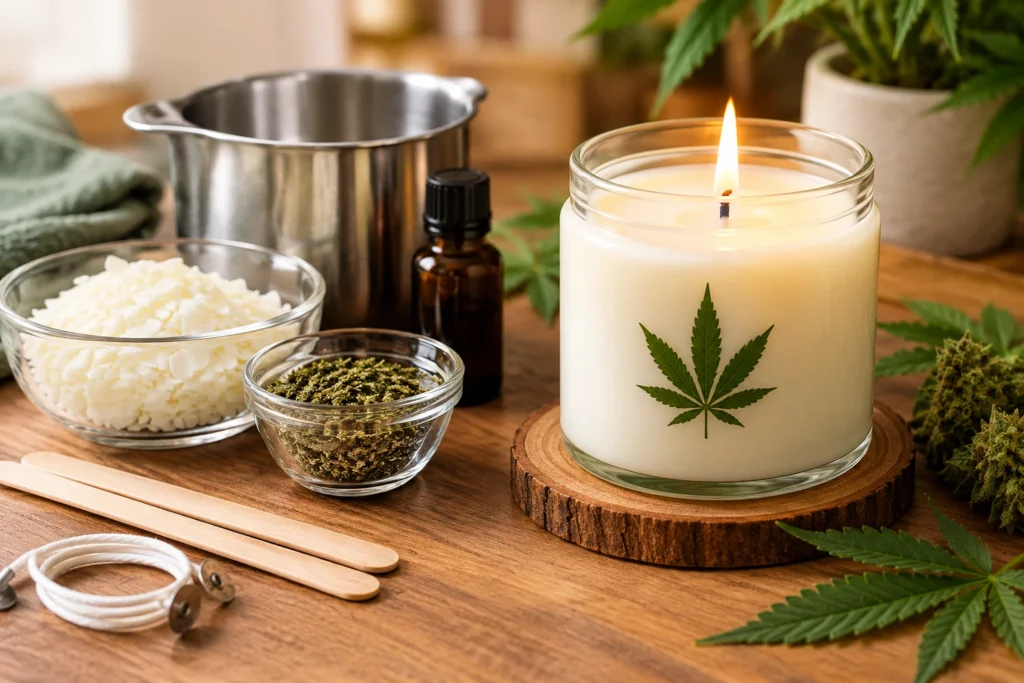
Quick Answer: If you want to know how to make a cannabis candle, the process is similar to making a regular scented candle. You’ll need candle-safe wax, a suitable fragrance, a wick, and a heat-safe container. Melt the wax according to the manufacturer’s instructions, secure the wick, mix in the appropriate fragrance, and carefully pour the wax into the container.
For safety, avoid adding cannabis flower, concentrates, or other raw plant material to hot wax because they can burn or produce unpredictable results. A homemade cannabis candle is best considered a scented or decorative product, not a reliable way to consume cannabis.
Looking for reliable cannabis information?
Get trustworthy information about cannabis products, responsible use, and medical marijuana options before trying a new cannabis-related product.
What Is a Cannabis Candle?
The phrase “cannabis candle” can describe several different products.
Some are simply candles with a cannabis-inspired fragrance. Others may contain hemp-derived ingredients, CBD, or other cannabis compounds. These products should not automatically be treated as interchangeable.
A scented candle can create a particular smell and atmosphere without containing cannabinoids at all. A candle containing CBD or THC introduces additional questions about ingredient quality, heating, stability, labeling, and intended use.
This distinction matters because smelling cannabis does not mean that you are consuming cannabis or receiving a measurable dose of THC or CBD.
The original source focuses heavily on CBD-infused wax and topical use, but the evidence for these claims is more limited than the article’s wording suggests. The FDA notes that there are still significant unanswered questions about the safety, quality, and effects of many consumer CBD products.
Can You Make a Cannabis Candle at Home?
Yes, you can make a candle using ordinary candle-making supplies and cannabis-inspired fragrances.
The safer DIY approach is to treat it like a regular scented candle, rather than trying to turn a candle into a homemade medical or therapeutic product.
For example, you can make a candle with:
- Soy, beeswax, or another candle-making wax
- A properly sized candle wick
- A candle-safe glass or metal container
- Cannabis-inspired fragrance oil
- Optional complementary candle fragrance notes
- A thermometer
- A double-boiler setup
- A wick holder or centering device
If you choose a fragrance oil, make sure it is specifically suitable for candle-making and follow the supplier’s recommended usage rate.
What You Need to Make a Cannabis Candle
Before starting, gather your supplies.
Basic materials
- Candle wax
- Candle-safe container
- Properly sized wick
- Wick adhesive or wick sticker
- Wick centering tool
- Candle fragrance oil
- Heat-safe pouring container
- Double boiler or controlled wax-melting setup
- Thermometer
- Kitchen scale
- Scissors or wick trimmer
A digital scale is useful because candle fragrance should generally be measured by weight rather than guessed by volume.
Why wick selection matters
The wick isn’t just there to create a flame. Its size affects how quickly the wax melts, how large the flame becomes, and whether the candle burns evenly.
A wick that is too large can produce excessive heat, soot, or an unstable flame. A wick that is too small may struggle to melt the wax evenly. For that reason, candle makers normally test different wick sizes when developing a new candle formula.
How to Make a Cannabis Candle Step by Step
Step 1: Prepare the Container
Start with a container designed for candle-making.
Do not simply use any drinking glass, decorative jar, or household container. A candle container needs to withstand repeated heating and cooling. Clean and completely dry the container before use. Place it on a stable, heat-resistant surface.
Step 2: Position the Wick
Attach the wick to the center of the bottom of the container using a candle-making wick sticker or another product designed for this purpose.
Use a wick-centering device to keep the wick upright while the wax is poured. A centered wick helps the candle burn more evenly.
Step 3: Melt the Wax Carefully
Measure the amount of wax you need and place it into a heat-safe melting container. Use a double-boiler setup or another method recommended by the wax manufacturer.
Heat the wax gradually and monitor the temperature with a thermometer. Avoid overheating the wax. Different waxes have different melting and pouring temperatures, so follow the instructions provided with the particular wax you’re using.
Step 4: Add Candle-Safe Fragrance
Once the wax reaches the manufacturer’s recommended temperature for fragrance addition, add your candle fragrance.
This is where you can create a cannabis-inspired scent profile.
For example, you might choose:
1. Earthy profile
- Pine
- Cedar
- Herbal notes
2. Citrus profile
- Lemon
- Orange
- Bergamot
3. Relaxing profile
- Lavender
- Cedarwood
- Soft herbal notes
Use only fragrance materials that are appropriate for candles and follow their supplier’s safety and usage instructions.
Do not assume that an essential oil is automatically safe or appropriate simply because it comes from a plant. Essential oils can cause irritation or other problems when misused, and some are not appropriate for direct skin use.
Step 5: Pour the Wax
Slowly pour the scented wax into your prepared container.
Try not to disturb the wick while pouring.
Leave enough space near the top rather than filling the container completely.
Once poured, check that the wick remains centered.
Step 6: Let the Candle Cool
Allow the candle to cool naturally in a draft-free location. Do not move it repeatedly while the wax is setting. Depending on the wax and container, the surface may take several hours to become completely firm.
Avoid lighting the candle immediately after it appears solid. Many candle formulas benefit from a longer curing period before their first burn.
Step 7: Trim the Wick Before Burning
Once the candle has fully set, trim the wick before lighting it. The National Candle Association recommends trimming candle wicks to approximately ¼ inch before burning.
This is different from the very short wick length suggested in the original article. A properly trimmed wick can help reduce excessive flame height, smoking, and uneven burning.
What About Adding CBD or THC to a Cannabis Candle?
This is where things become more complicated.
The original source recommends adding CBD, CBG, CBN, or other oils to melted wax. However, simply mixing a cannabinoid oil into candle wax does not establish that the resulting product will deliver a predictable amount of cannabinoid or provide a therapeutic benefit.
There are several reasons to be cautious.
1. Heat can change cannabis compounds
Cannabinoids are chemically sensitive compounds, and heat can affect their stability. THC and THCA also have different properties when exposed to heat. The CDC explains that THCA can convert to THC when exposed to heat.
That does not mean that burning a CBD or cannabis candle will produce a predictable cannabis effect.
2. A candle is not a controlled delivery system
A properly manufactured topical product is formulated with a particular purpose in mind.
A homemade candle has many variables, including:
- Wax type
- Fragrance concentration
- Wick size
- Burn temperature
- Container size
- Burning duration
- Amount and type of cannabinoid
- How evenly the ingredient is distributed
Because of these variables, it is difficult to determine how much cannabinoid would remain in the wax or how much, if any, would be absorbed through the skin.
The FDA specifically notes that important questions remain about CBD exposure, including how much CBD may be absorbed through the skin from topical products.
Can Cannabis Candle Wax Be Used Directly on Your Skin?
This is one of the biggest areas where caution is needed. A candle made for burning should not automatically be treated as a body-safe massage candle.
Even if the wax contains CBD or botanical oils, that does not prove that the finished product is suitable for skin application.
There are several things to consider:
- The wax may become hot enough to cause burns.
- Fragrance ingredients may irritate sensitive skin.
- Essential oils can cause allergic or irritation reactions.
- The finished formulation may not have been tested for dermal safety.
- CBD absorption from topical products remains an area with limited data.
- Adding a cannabinoid does not automatically make a candle a therapeutic product.
The FDA states that many CBD products have not been evaluated for safety or effectiveness for the medical claims made about them.
If your goal is a product intended for skin use, a properly formulated topical product designed and labeled for that purpose is a more appropriate category than a homemade household candle.
Cannabis Candle vs. CBD Candle vs. Cannabis-Scented Candle
These terms are often confused.
| Product | Contains cannabis compounds? | Main purpose |
|---|---|---|
| Cannabis-scented candle | Not necessarily | Fragrance and ambiance |
| CBD candle | May contain CBD | Candle product containing CBD |
| THC candle | May contain THC | Cannabis-containing candle product |
| CBD topical | Designed for skin application | Topical use |
| Regular scented candle | No | Fragrance and ambiance |
A product’s name alone does not tell you exactly what is inside it. Always check the ingredient information and intended-use instructions.
How to Choose a Cannabis-Inspired Candle Fragrance
If your main goal is the smell rather than cannabinoid delivery, you can create a cannabis-inspired candle without adding cannabis extracts.
Some fragrance combinations can create an earthy, herbal profile.
1. Earthy and woody
Try combining fragrance notes such as:
- Cedarwood
- Pine
- Earthy herbal notes
2. Fresh and citrusy
Consider:
- Lemon
- Orange
- Bergamot
- Herbal notes
3. Herbal and floral
You might combine:
- Lavender
- Rosemary
- Herbal fragrance
- Soft wood notes
Always check that the specific fragrance product is approved for candle use and follow the manufacturer’s recommended fragrance load.
How to Make Your Candle Burn More Evenly
A good-looking candle can still burn poorly if the wick and wax combination has not been tested.
Here are a few useful practices:
1. Trim the wick before every burn
The National Candle Association recommends a wick length of about ¼ inch before lighting.
2. Keep the wax pool clean
Remove pieces of wick, matches, and other debris from the melted wax.
Debris can become additional fuel and increase the risk of an unexpectedly large flame.
3. Avoid drafts
Fans, air-conditioning vents, and open windows can disturb a candle flame and contribute to uneven burning or soot.
4. Follow the wax manufacturer’s instructions
There isn’t one universal temperature or recipe for every type of candle wax.
Soy wax, beeswax, paraffin, and wax blends can have different handling requirements.
Cannabis Candle Safety Tips
Candle safety is just as important as the recipe.
The National Candle Association recommends several basic precautions:
- Never leave a burning candle unattended.
- Keep candles away from anything that can catch fire.
- Keep candles away from children and pets.
- Place candles on stable, heat-resistant surfaces.
- Keep candles away from drafts.
- Trim the wick before burning.
- Keep the melted wax free of debris.
- Follow the manufacturer’s recommended burn time.
- Allow the candle to cool before moving it.
The National Candle Association generally recommends not burning a candle for more than four hours at a time, although the manufacturer’s instructions for a particular candle should take priority.
Never use water to put out a candle flame because hot wax can splatter and water can cause some containers to break.
Can a Cannabis Candle Get You High?
A cannabis-scented candle should not be confused with inhaling cannabis.
Simply having a candle with a cannabis-like aroma does not mean that you are receiving a recreational dose of THC.
However, a candle containing THC or another cannabinoid is a different situation. The effects of heating and burning cannabinoids depend on the specific formulation and conditions, and a homemade candle should not be considered a predictable cannabis-delivery method.
THC is the cannabinoid associated with the intoxicating effects of cannabis, while CBD does not produce the same intoxicating effect.
Are Cannabis Candles Legal?
The answer depends on the ingredients, product type, and jurisdiction.
Cannabis and cannabis-derived products can be subject to different federal, state, and local rules. Hemp-derived CBD and marijuana-derived THC are not necessarily treated the same way under applicable laws.
The FDA also retains authority over products containing cannabis-derived compounds, regardless of how they are classified under other laws.
If you plan to sell cannabis or CBD candles rather than make one for personal use, you should check the laws that apply where the product will be manufactured and sold. Product labeling and health claims can also create additional regulatory issues.
Should You Make a CBD-Infused Candle or a Cannabis-Scented Candle?
It depends on what you actually want from the candle.
If your goal is ambiance and fragrance, a cannabis-inspired scented candle is the simpler option.
If your goal is skin application, a candle is not necessarily the right product. Look for a topical product that has been specifically formulated and labeled for use on skin.
If your goal is cannabis consumption or cannabinoid effects, a candle is not a reliable substitute for a product designed and tested for that route of administration.
This distinction can prevent a common mistake: assuming that adding CBD or cannabis oil to wax automatically creates a therapeutic cannabis product.
Common Mistakes to Avoid
1. Using a random glass container
Household glass is not necessarily designed to withstand the repeated temperature changes produced by a burning candle. Use a container intended for candle-making.
2. Adding too much fragrance
More fragrance does not necessarily mean a better candle. Excess fragrance can interfere with how a candle burns. Follow the fragrance manufacturer’s recommended usage rate.
3. Using an oversized wick
A wick that is too large can create an unnecessarily large flame and excessive heat.
4. Applying homemade candle wax to your skin
A candle made for burning is not automatically a skin-care product.
5. Making medical claims
Do not assume that a CBD or cannabis candle treats pain, anxiety, inflammation, insomnia, or another health condition. The FDA warns that many CBD products are marketed with unproven therapeutic claims.
Frequently Asked Questions
1. What is a cannabis candle?
A cannabis candle is generally a candle associated with cannabis, hemp, cannabis-inspired fragrance, or cannabinoid ingredients. The term can refer to very different products, so checking the ingredients and intended use is important.
2. Can you make a cannabis candle at home?
Yes. You can make a cannabis-inspired scented candle at home using candle wax, a suitable container, a wick, and candle-safe fragrance. Making a candle that contains CBD or THC involves additional formulation and safety considerations.
3. Can a cannabis candle get you high?
A cannabis-scented candle does not work like smoking or consuming cannabis. A candle containing THC is more complicated, and burning cannabinoids does not provide a predictable dose or effect.
4. Can you put CBD oil in candle wax?
CBD oil can be mixed into wax, but that does not mean the finished candle will deliver a predictable amount of CBD or provide a proven therapeutic effect. Cannabinoid stability, heat, formulation, and skin absorption all create uncertainties.
5. Can you use cannabis candle wax as massage oil?
Not automatically. A candle intended for burning has not necessarily been formulated or tested for direct skin application. Only use a product specifically designed and labeled for skin contact.
6. What wax is best for a cannabis candle?
There is no single wax that is automatically best. Soy wax, beeswax, paraffin, and blends can all be used for candle-making. The choice should take into account the container, fragrance, wick, and manufacturer’s instructions.
7. What fragrance smells like cannabis?
Cannabis-inspired fragrance profiles often use combinations of earthy, herbal, woody, pine, or citrus notes. The exact aroma depends on the fragrance formulation.
8. How long should you burn a cannabis candle?
Follow the candle manufacturer’s instructions. The National Candle Association generally recommends not burning candles for more than four hours at a time.
9. Should I use essential oils in a cannabis candle?
Only use essential oils that are appropriate for candle applications and follow the supplier’s instructions. Essential oils are concentrated substances and can cause adverse reactions when misused.
10. Is a CBD candle medically proven to work?
There is not enough evidence to treat a homemade CBD candle as a proven medical treatment. The FDA says significant questions remain about CBD’s safety, quality, exposure, and effectiveness for many consumer uses.
Final Thoughts
Making a cannabis candle can be a fun candle-making project, especially if your goal is to create an earthy, herbal, or cannabis-inspired fragrance.
The safest approach is to treat the project like candle-making rather than trying to turn a household candle into a medical treatment. Use candle-safe materials, choose the correct wick, follow the wax and fragrance manufacturer’s instructions, and practice basic fire safety.
If you’re considering adding CBD or THC, be more cautious. A cannabinoid-containing candle does not automatically provide a predictable dose, topical benefit, or medical effect. Current evidence and regulatory guidance leave important questions about many consumer CBD products unanswered.
For that reason, it’s useful to separate cannabis-inspired fragrance, cannabinoid-containing candles, and properly formulated cannabis or CBD topical products rather than treating them as the same thing.