Is Medical Marijuana Better Than Recreational? Key Differences

Is Medical Marijuana Better Than Recreational

Quick Answer: Is medical marijuana better than recreational cannabis? It depends on what you mean by “better” and why you want to use cannabis.

Medical marijuana is intended for people using cannabis as part of a state-regulated medical program, while recreational cannabis, more accurately called adult-use cannabis is generally intended for adults who choose to use cannabis without a medical authorization. The cannabis itself is not always completely different. Both medical and adult-use products can contain THC, CBD, or other cannabinoids, and both can cause intoxicating effects when they contain THC.

The biggest differences are often related to purpose, state regulations, patient eligibility, purchasing rules, taxes, possession limits, and access to medical programs. The exact rules vary by state.

Many people searching for cannabis information eventually ask the same question: Is medical marijuana better than recreational? It sounds like there should be a simple yes-or-no answer. But the difference is more complicated.

Medical marijuana and recreational cannabis can come from the same plant. Both may contain THC, the cannabinoid responsible for most of cannabis’s intoxicating effects, and CBD, which does not produce the typical THC “high.”

What changes is how the cannabis is being used and how the state regulates it.

Someone looking for cannabis to help manage a health concern may have different needs from someone who wants to use cannabis for personal or social reasons. Medical programs may also provide certain legal or financial benefits that are not available through adult-use programs, depending on the state.

Before choosing either option, it helps to understand what actually makes them different.

Looking for Medical Cannabis?

If you’re considering medical marijuana for a qualifying health condition, an online evaluation can help you learn whether you may qualify for your state’s medical cannabis program.

>>Book Your Online Evaluation<<

What Is Medical Marijuana?

Medical marijuana refers to cannabis used under a state’s medical cannabis program for qualifying patients.

The exact requirements depend on where you live. Some states require a patient to have a qualifying medical condition and obtain certification or authorization from a healthcare professional. Others have different rules for registration, possession, purchasing, or cultivation.

Medical cannabis may contain different amounts of THC and CBD. Having a medical designation does not automatically mean that a product contains little or no THC.

THC can cause intoxication and can affect memory, attention, decision-making, coordination, and reaction time.

What Is Recreational Cannabis?

“Recreational cannabis” usually refers to cannabis purchased and used under a state’s adult-use cannabis laws.

In states where adult-use cannabis is legal, adults who meet the state’s age requirements can generally purchase cannabis without joining a medical cannabis program. However, the exact rules differ by state.

Adult-use cannabis may be available in many forms, including:

  • Flower
  • Pre-rolls
  • Vapes
  • Edibles
  • Oils
  • Concentrates
  • Other infused products

These products can contain THC, CBD, or both.

So, the word “recreational“ does not necessarily describe a particular type of cannabis plant or product. It mainly describes the legal and intended use category.

Is Medical Marijuana Actually Different From Recreational Cannabis?

Sometimes, but not always.

This is one of the biggest points people miss when comparing medical marijuana with recreational cannabis.

A medical cannabis product is not automatically a completely different substance from an adult-use product. In some markets, similar or even identical types of cannabis products may be available through both systems.

The differences may instead involve:

  • Who can purchase the product
  • Whether a medical authorization is required
  • Minimum age
  • Possession limits
  • Purchase limits
  • Product regulations
  • Taxes
  • Cultivation rules
  • Where cannabis can legally be used
  • Patient protections
  • Access to specific medical products

These rules are established at the state level and can change over time.

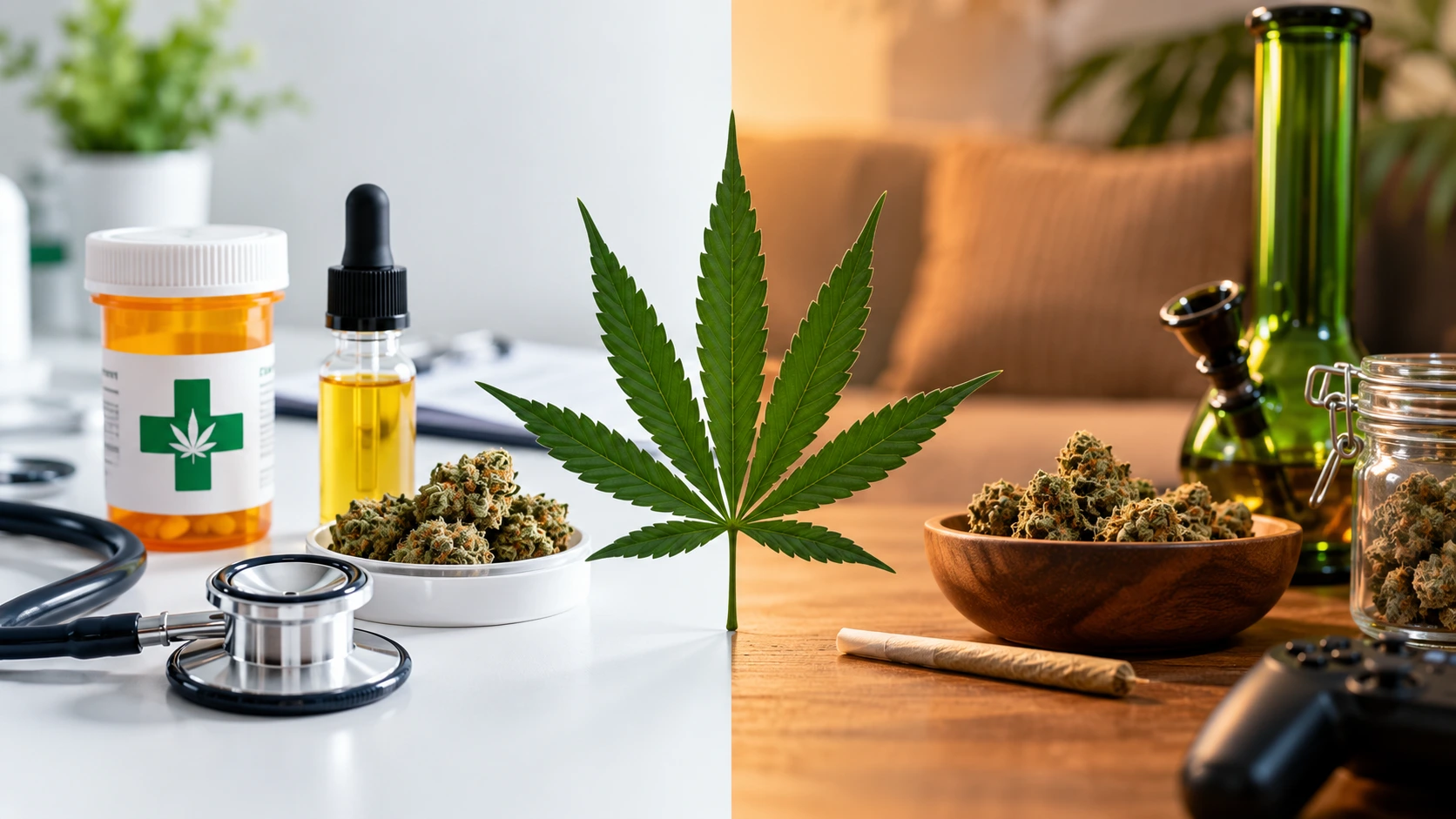
Medical Marijuana vs Recreational Cannabis: Key Differences

Feature Medical Marijuana Recreational Cannabis
Main purpose Used as part of a medical cannabis program Adult personal use
Medical authorization Often required Generally not required
Eligibility Depends on state medical rules Depends mainly on adult-use age requirements
THC products May be available May be available
CBD products May be available May be available
Taxes May differ by state May be higher in some states
Possession limits State-specific State-specific
Home growing May have different rules May have different rules
Product access Can depend on the medical program Can depend on adult-use regulations
Rules Vary by state Vary by state

This table is a general comparison. Your state’s laws may be different, so check current state regulations before relying on any specific limit or rule. NCSL maintains a current database of state cannabis legislation.

Why Do People Choose Medical Marijuana?

People may consider a medical cannabis program because they are looking for cannabis as part of their approach to managing a health condition or symptom.

The potential reasons vary widely. Some people discuss cannabis with a healthcare professional because of issues such as pain, nausea, sleep problems, or other symptoms.

However, cannabis is not appropriate for everyone, and evidence differs depending on the condition and the cannabis product being considered.

The CDC notes that researchers are still learning about both the potential benefits and risks of cannabis. It also points out that state-legal medical cannabis products are not the same as FDA-approved cannabis medicines.

Does Medical Marijuana Have More THC Than Recreational Cannabis?

Not necessarily.

There is a common assumption that medical cannabis must always contain less THC than recreational cannabis. That is not a reliable rule.

Medical cannabis can contain THC, and some products can contain relatively high concentrations. Adult-use products can also contain high amounts of THC.

The amount of THC matters because THC is the main compound responsible for cannabis intoxication. Higher-THC products can produce stronger effects and may increase the risk of overconsumption.

Instead of assuming that “medical” means low THC, look at the actual product information and follow the instructions provided for your situation.

What Is the Difference Between THC and CBD?

THC and CBD are two different cannabinoids found in cannabis.

THC

THC, or tetrahydrocannabinol, is the cannabinoid primarily associated with the cannabis “high.”

THC can affect:

  • Memory
  • Attention
  • Coordination
  • Decision-making
  • Reaction time
  • Perception

The effects can vary from person to person.

CBD

CBD, or cannabidiol, does not cause the typical high associated with THC.

However, that does not mean CBD products are completely risk-free. The CDC notes that CBD may cause side effects, can interact with some medications, and many CBD products are not FDA-regulated.

So if your concern is specifically about feeling intoxicated, the amount of THC in a product is more relevant than simply whether the product is labeled “medical” or “recreational.”

Is Medical Marijuana Safer Than Recreational Cannabis?

It would be too broad to say that medical marijuana is automatically safer.

Safety depends on several factors, including:

  • THC concentration
  • Amount used
  • Frequency of use
  • Method of consumption
  • Individual response
  • Previous cannabis experience
  • Other medicines or substances being used
  • Age and health history

The CDC states that how cannabis affects someone depends on factors such as the amount used, how often it is used, the method of use, previous experience, biology, and whether it is combined with other substances.

A medical program may provide additional healthcare guidance, but the word “medical” alone does not remove the potential risks of THC.

Does Medical Marijuana Get You High?

It can.

If a medical cannabis product contains enough THC, it can produce intoxicating effects.

Some people may experience:

  • Euphoria
  • Relaxation
  • Sleepiness
  • Changes in perception
  • Slower reaction time
  • Difficulty concentrating
  • Dizziness
  • Anxiety or uncomfortable feelings

Not everyone experiences these effects in the same way.

CBD by itself does not produce the typical THC high.

Can Recreational Cannabis Be Used for Medical Reasons?

A person may personally use adult-use cannabis because they believe it helps a symptom, but that is not necessarily the same thing as participating in a state’s medical cannabis program.

This distinction matters because medical and adult-use programs can have different legal requirements and patient protections.

If someone wants to use cannabis specifically for a health concern, discussing it with a qualified healthcare professional can help them understand potential benefits, risks, interactions, and other treatment options.

Are Medical Cannabis Products More Carefully Controlled?

The answer depends on the state and the specific product.

Cannabis regulations vary significantly across the United States. States can set their own rules for testing, labeling, licensing, product types, possession, and sales.

The CDC also notes that there are currently no federal standards for the quality and safety of cannabis products sold through state medical cannabis dispensaries. That is why consumers should not assume that every product labeled “medical” has the same level of oversight as an FDA-approved prescription medicine.

Medical Marijuana and Recreational Cannabis Can Have Similar Side Effects

The medical or recreational label does not eliminate the effects of THC.

THC-containing cannabis may affect attention, memory, coordination, judgment, and reaction time.

Other possible effects can include:

  • Dry mouth
  • Drowsiness
  • Dizziness
  • Increased heart rate
  • Anxiety
  • Confusion
  • Problems with concentration

The experience depends on the individual and the product.

Products with high THC concentrations can have stronger intoxicating effects and may increase the risk of consuming too much.

Does the Way You Use Cannabis Matter?

Yes.

The method of consumption can change how quickly effects appear and how long they last.

For example, inhaled cannabis can produce effects relatively quickly, while edible cannabis can take longer to produce noticeable effects.

The delayed effects of edibles are particularly important because someone may consume more before realizing that the first amount has taken effect. The CDC warns that edible cannabis can take 30 minutes to 2 hours to produce intoxicating effects and can cause effects that last longer than expected.

This is one reason people should follow product instructions carefully and avoid taking additional amounts simply because effects have not appeared yet.

Which Is Better for Medical Use?

There is no single answer that applies to everyone.

If someone has a medical reason for considering cannabis, a medical cannabis program may offer advantages related to patient eligibility, healthcare guidance, or state-specific protections.

If someone does not qualify for a medical program and lives somewhere adult-use cannabis is legal, an adult-use program may be the available legal option.

The important question is not simply:

“Is medical marijuana better than recreational?”

A better question is:

“Which option fits my health needs, legal situation, and goals?”

The answer depends on the person’s circumstances and the laws where they live.

Are Medical Marijuana Products Less Intoxicating?

Not automatically.

A product’s intoxicating effect is influenced largely by its THC content and how it is used not simply by whether it was purchased through a medical or adult-use program.

A medical product with THC can make someone feel high.

Likewise, an adult-use product with lower THC may produce less noticeable intoxication. Always check the product’s cannabinoid information rather than assuming that the category tells you how strong its effects will be.

Can You Drive After Using Medical or Recreational Cannabis?

Using cannabis can impair skills needed for safe driving.

THC can affect attention, coordination, decision-making, and reaction time. That means having a medical cannabis authorization does not make it safe to drive while impaired.

The same principle applies to adult-use cannabis. Do not drive, operate machinery, or perform other safety-sensitive activities if cannabis has impaired you.

Can Medical Marijuana Be Better for Cost?

Sometimes, but it depends on the state.

Medical and adult-use cannabis can be subject to different tax structures and purchase rules. Some states provide tax advantages to registered medical cannabis patients, while others may have different pricing or purchasing rules.

Because cannabis laws change, cost should be checked using current state information rather than assuming that medical cannabis is always cheaper.

Can Medical Marijuana Help You Avoid a “Recreational” Label?

A medical cannabis program is different from adult-use cannabis in terms of legal status and program participation.

But it is important not to assume that having medical authorization changes every cannabis-related law. Rules involving driving, employment, federal law, firearms, housing, public consumption, and other issues can be complicated and may vary by jurisdiction.

For legal questions, check the current laws that apply to your location.

What About Drug Testing?

Medical authorization does not necessarily mean a cannabis drug test will be negative.

Many drug tests look for cannabis-related metabolites rather than asking whether cannabis was used medically or recreationally. Therefore, a medical cannabis authorization does not automatically prevent THC-related test results.

Employment and drug-testing laws vary by location and situation, so anyone concerned about workplace testing should check the rules that apply to them.

Does Having a Medical Card Mean Cannabis Is Completely Legal?

No.

A medical cannabis card or authorization generally operates within a state’s medical cannabis framework. It does not make cannabis legal everywhere or remove every restriction.

State cannabis programs can have rules covering:

  • Where cannabis can be purchased
  • How much can be possessed
  • Where it can be used
  • Home cultivation
  • Transportation
  • Age requirements
  • Driving
  • Product types

State laws also change. NCSL’s cannabis legislation database tracks enacted cannabis laws across states and is updated regularly.

What Should You Consider Before Choosing Medical or Recreational Cannabis?

If you’re deciding between the two, consider these questions:

1. Why do you want to use cannabis?

If the reason is related to a health condition or symptom, speaking with a healthcare professional can help you understand whether cannabis is appropriate.

2. Do you qualify for your state’s medical program?

Eligibility requirements vary by state.

3. What are the costs?

Compare product prices, taxes, registration fees, and other costs that apply in your state.

4. What THC level is appropriate?

THC strength can affect intoxication and the likelihood of unwanted effects. Higher THC concentrations can produce stronger effects.

5. Are you taking other medications?

Cannabis and CBD can interact with other medicines. The CDC specifically warns that CBD may interfere with some medications.

6. Do you need to drive or work soon afterward?

If cannabis affects your attention, coordination, or reaction time, driving or other safety-sensitive activities can become dangerous.

So, Is Medical Marijuana Better Than Recreational?

Medical marijuana is not automatically better than recreational cannabis, and recreational cannabis is not automatically better than medical cannabis.

They serve different purposes and operate under different state rules.

Medical marijuana may make more sense for someone who wants to participate in a state medical cannabis program for a health-related reason. Adult-use cannabis may be the legal option for adults who want cannabis for personal use in a state that permits it.

The actual cannabis product also matters. THC content, CBD content, potency, method of use, and individual response can all affect the experience. If you are considering cannabis for a medical reason, the most useful starting point is to understand your state’s medical program and discuss your situation with a qualified healthcare professional.

Frequently Asked Questions

Is medical marijuana better than recreational cannabis?

Not necessarily. The two are regulated for different purposes, and the better option depends on your medical needs, eligibility, location, cost, and applicable laws.

Does medical marijuana have less THC?

Not always. Medical cannabis can contain THC at different concentrations, including products with relatively high THC levels.

Does medical marijuana get you high?

It can if the product contains THC. THC is the primary cannabinoid responsible for cannabis intoxication.

Does CBD get you high?

CBD by itself does not cause the typical THC high. However, CBD products may contain THC or other substances, so product labeling matters.

Is recreational marijuana stronger than medical marijuana?

Not necessarily. Strength depends on the specific product and its THC concentration rather than simply whether it is sold through a medical or adult-use program.

Is medical marijuana safer than recreational marijuana?

The medical designation does not automatically make cannabis safer. Risks can depend on THC concentration, amount used, method of consumption, individual factors, and other substances or medications.

Can you drive after using medical marijuana?

Medical authorization does not make driving while impaired safe. THC can affect attention, coordination, judgment, and reaction time.

Can you use recreational marijuana for medical reasons?

Someone may personally use adult-use cannabis for a symptom, but that is different from participating in a state’s medical cannabis program. The legal rules depend on the state.

Is medical marijuana cheaper than recreational marijuana?

It can be in some states because medical cannabis programs may have different taxes or fees. However, prices and rules vary, so there is no universal answer.

Does having a medical marijuana card protect you from drug testing?

No. A medical authorization does not necessarily prevent a cannabis-related drug test from detecting THC metabolites. Workplace and testing rules vary.

Final Thoughts

When asking “Is medical marijuana better than recreational?” there is no universal answer.

Medical cannabis and adult-use cannabis can contain many of the same cannabinoids, including THC and CBD. The major differences often come from why cannabis is being used, who can access each program, state regulations, taxes, possession rules, and available patient protections.

Most importantly, don’t assume that medical cannabis cannot make you high or that it is automatically safer. THC can cause intoxication regardless of whether cannabis was obtained through a medical or adult-use program.

If you’re considering cannabis for a health concern, learn the rules in your state and talk with a qualified healthcare professional about potential benefits, risks, and other treatment options.

Sources

What’s the Real Purpose of a Medical Marijuana Card?

Purpose of a Medical Marijuana Card

Quick Answer: The purpose of a medical marijuana card is to show that a patient has been approved to use medical cannabis under their state’s medical marijuana program. Depending on the state, a medical marijuana card may allow a qualified patient to purchase cannabis from licensed dispensaries, possess certain amounts, and sometimes grow cannabis at home.

However, a medical marijuana card does not mean you can use cannabis anywhere or at any time. It generally does not allow you to drive while impaired, use cannabis in places where consumption is prohibited, or ignore possession and purchase limits. The exact rules and benefits vary by state.

Many people hear about medical marijuana cards but are not sure what they actually do.

Some people think a medical marijuana card is simply a document that lets them buy cannabis. Others wonder whether it provides tax benefits, protects them at work, allows home growing, or gives them permission to carry cannabis in public.

The answer is that a medical marijuana card can provide several benefits, but those benefits depend heavily on the state where you live.

State medical cannabis programs have their own rules for qualifying conditions, patient registration, possession limits, dispensary purchases, cultivation, and other requirements. Because these laws can change, it is important to check your state’s current rules before relying on a medical marijuana card.

Looking Into a Medical Marijuana Card?

If you’re considering a medical marijuana card, start by checking your state’s eligibility requirements and medical cannabis rules. Understanding the process, costs, and patient benefits can help you decide whether a medical cannabis program is right for you.

>>Contact Us<<

What Is a Medical Marijuana Card?

A medical marijuana card, sometimes called a medical cannabis card or patient registration card, is issued through a state medical cannabis program.

It identifies a person as a registered or authorized medical cannabis patient. Depending on the state’s system, the patient may receive a physical card, digital identification, or another form of official authorization.

The card itself is not a general permission slip to use cannabis however you want. Instead, it is connected to the state’s medical cannabis rules.

For example, a state may require a patient to:

  1. Have a qualifying medical condition.
  2. Receive an evaluation or certification from an authorized healthcare professional.
  3. Register with the state’s medical cannabis program.
  4. Pay a state registration fee, if required.
  5. Follow possession, purchase, and use restrictions.

The specific process is different from one state to another.

What Is the Purpose of a Medical Marijuana Card?

The main purpose of a medical marijuana card is to establish that a person is authorized to participate in a state’s medical cannabis program.

Here are some of the most common reasons people obtain one.

1. It May Allow You to Buy Medical Cannabis

One of the most common purposes of a medical marijuana card is to give registered patients access to licensed medical cannabis dispensaries.

In states with medical marijuana programs, patients may need to show proof of their registration before purchasing products through the medical system.

Depending on the state, the program may provide access to products that are not available through the adult-use market. This can include different product types, purchase limits, or product strengths, although these rules vary by state.

2. It May Allow Legal Possession Under State Law

A medical marijuana card can also establish that you are authorized to possess cannabis for medical purposes under applicable state law. The amount you can possess is not unlimited.

States can establish specific possession limits for registered patients. Some programs may use weight limits, purchase limits, supply limits, or other restrictions.

This is why having a card does not mean you can carry any amount of cannabis you want. If you are a medical cannabis patient, learn your state’s possession rules and keep your registration current.

3. It May Provide Access to Medical-Only Products

Another possible benefit is access to products or purchase options reserved for medical cannabis patients. The exact products available depend on state regulations and individual dispensaries.

In some states, medical patients may have access to different purchasing limits or products than adult-use customers. This is one reason some people continue using a medical program even after recreational cannabis becomes legal in their state.

4. It May Reduce Cannabis Costs

A medical marijuana card may also help some patients save money. Depending on state and local rules, registered medical patients may receive lower cannabis taxes, discounts, or other pricing advantages.

For example, some people in online discussions report keeping their medical cards because they pay less tax or receive other dispensary benefits.

However, these savings are not guaranteed everywhere. Before getting or renewing a card, compare the cost of the card and registration with the actual benefits available in your state.

5. It May Allow Home Cultivation in Some States

Home growing is another area where medical marijuana cards can matter. Some states allow registered medical cannabis patients to grow a limited number of plants for personal medical use.

Other states do not allow medical patients to grow cannabis at home.

Even when home cultivation is allowed, there may be strict rules about:

  • Number of plants
  • Where plants can be grown
  • Who can grow them
  • Security requirements
  • Whether plants must be kept out of public view
  • Whether cannabis can be transferred to another person

Therefore, never assume that having a medical marijuana card automatically gives you permission to grow cannabis.

Check your state’s current cultivation rules first.

6. It May Provide Certain Patient Protections

Some states provide specific legal protections to registered medical cannabis patients. These protections can relate to possession, employment, or other areas of state law.

However, employment protections are particularly complicated.

According to the National Conference of State Legislatures, some states have laws addressing employment protections for medical cannabis patients, while many states leave cannabis-related workplace policies largely to employers.

So, a medical marijuana card should not automatically be treated as protection against every workplace drug-testing or employment issue.

7. It Can Help Establish Your Medical Cannabis Status

A medical marijuana card can also provide proof that you are participating in your state’s medical cannabis program.

This can be important when purchasing cannabis through a medical dispensary or when you need to demonstrate your patient status under applicable state rules.

Still, carrying a card does not replace the need to follow other cannabis laws.

What Does a Medical Marijuana Card NOT Allow You to Do?

Understanding the limits of a medical marijuana card is just as important as understanding its benefits.

A card generally does not give you permission to ignore other laws.

1. You Cannot Drive While Impaired

A medical marijuana card does not make impaired driving legal. If cannabis affects your ability to safely operate a vehicle, having a medical card does not give you permission to drive.

Always follow your state’s impaired-driving laws.

2. You Cannot Automatically Smoke in Public

Having a medical marijuana card does not usually mean you can consume cannabis wherever you want. Public consumption may be prohibited even when cannabis is legal for medical or adult use.

A medical card does not automatically turn a public location into a legal place for cannabis consumption.

3. You Cannot Ignore Possession Limits

Your card does not give you unlimited possession rights. Medical cannabis programs generally have specific rules governing how much cannabis a registered patient can purchase or possess.

Exceeding those limits can create legal problems.

4. You Cannot Assume You Can Grow at Home

Home cultivation depends on state law.

Some medical programs allow it, while others do not. Even states that permit cultivation can place limits on the number of plants and growing conditions.

5. You Cannot Assume Your Card Works Everywhere

A medical marijuana card is generally connected to the laws of the state that issued it. Some states recognize medical cannabis cards from other states under certain circumstances, while others do not.

If you travel, check the destination state’s rules before carrying or purchasing cannabis.

Why Do People Get a Medical Marijuana Card?

People have different reasons for joining a medical cannabis program.

Common reasons include:

  • Access to medical cannabis through licensed dispensaries
  • Legal authorization under a state’s medical cannabis program
  • Potential tax savings
  • Access to medical-only products or purchase limits
  • Possible home cultivation rights
  • Certain state-level legal protections
  • Continued access to the medical cannabis system after recreational legalization

The value of a medical marijuana card depends on your personal circumstances and your state’s laws.

For someone living in a state where recreational cannabis is legal, for example, the card may still provide financial or product-related advantages.

For someone living in a state with only a medical cannabis program, the card may be necessary to legally participate in that program.

Medical Marijuana Card vs. Recreational Cannabis

A common question is whether someone still needs a medical marijuana card when recreational cannabis is legal.

There is no single answer.

A state may offer both medical and adult-use cannabis programs, but the two systems can have different rules.

Medical Cannabis Adult-Use Cannabis
Usually requires patient registration or authorization Usually based on adult-use eligibility
Intended for qualifying medical patients Intended for adult consumers
May have medical-specific products or limits May have different purchase rules
May offer tax or pricing advantages in some states Taxes may be higher depending on the state
May allow home cultivation under certain laws Home cultivation rules vary
May provide certain state-level patient protections Generally does not provide medical-patient status

The differences are state-specific, so always check current local rules.

How Does a Medical Marijuana Card Work?

The process generally follows several steps.

Step 1: Check Your State’s Medical Cannabis Program

Start by finding out whether your state has a medical cannabis program and whether you qualify.

State rules can cover qualifying conditions, age requirements, residency, documentation, and other criteria.

Step 2: Complete a Medical Evaluation

If your state requires healthcare-professional certification, you may need an evaluation with an authorized physician or other qualified provider.

The provider determines whether you meet the state’s requirements.

Step 3: Apply or Register

After receiving the required certification, you may need to submit an application to the state’s medical cannabis program.

The application process and fees vary.

Step 4: Receive Your Patient Identification

If your application is approved, you may receive a medical marijuana card or another form of patient authorization.

Keep your registration information current.

Step 5: Purchase Cannabis According to State Rules

Once registered, you can use your authorization according to your state’s medical cannabis laws.

This may include purchasing cannabis from licensed dispensaries and following the state’s possession and purchase limits.

Does a Medical Marijuana Card Mean Cannabis Is Legal Everywhere?

No.

This is one of the most important things to understand about medical marijuana cards.

Cannabis laws differ between states and jurisdictions. A state medical marijuana card does not mean cannabis can be used in every location or under every circumstance.

The National Conference of State Legislatures maintains a state cannabis policy database because medical and adult-use cannabis laws differ across jurisdictions and continue to change.

There can also be differences between state and federal law. Federal cannabis policy has been undergoing regulatory changes, including proceedings related to marijuana’s classification under the Controlled Substances Act.

For this reason, patients should not assume that state authorization answers every federal legal question.

Can You Carry Cannabis in Your Car With a Medical Card?

This depends on state law.

A medical marijuana card may authorize possession under certain circumstances, but transportation rules can still apply. A card does not give you permission to use cannabis while driving or operate a vehicle while impaired.

If your state has specific rules for transporting cannabis, follow them carefully. Some jurisdictions may also have requirements involving packaging, storage, or where cannabis can be kept inside a vehicle.

Can You Use Medical Marijuana at Work?

Not necessarily.

Having a medical marijuana card does not automatically mean you can consume cannabis at work or use it during working hours.

Workplace policies and state employment laws can be very different.

Some states provide certain protections for registered medical cannabis patients, while others give employers more freedom to enforce drug policies.

If your job involves drug testing, driving, operating machinery, healthcare, public safety, or other safety-sensitive responsibilities, review the applicable rules carefully.

What Should You Know Before Getting a Medical Marijuana Card?

Before applying, ask yourself a few practical questions:

Does my state have a medical cannabis program?

Check the current state rules rather than relying on information from another state.

Do I meet the qualifying requirements?

Medical cannabis programs can have specific eligibility rules.

What benefits does the card provide?

Look at dispensary access, taxes, purchase limits, cultivation rules, and other benefits.

How much does the card cost?

Consider application, registration, evaluation, and renewal costs.

How often does it need to be renewed?

Card and registration periods differ by state.

Will my state recognize another state’s card?

Do not assume that your card automatically works when traveling.

What are the restrictions?

Understand possession, transportation, consumption, cultivation, and workplace rules before using cannabis.

Frequently Asked Questions

What is the main purpose of a medical marijuana card?

The main purpose is to identify a person as an authorized medical cannabis patient under a state’s medical marijuana program. Depending on the state, it may allow the patient to purchase and possess medical cannabis and receive other program-specific benefits.

Does a medical marijuana card let you buy weed?

In states with medical cannabis programs, an active patient registration or card may allow qualifying patients to purchase cannabis from licensed medical dispensaries. The exact purchasing rules depend on the state.

Does a medical marijuana card make it legal to smoke anywhere?

No. A medical marijuana card does not generally allow cannabis consumption in places where it is prohibited. Public-use restrictions can still apply.

Can you drive with a medical marijuana card?

You may be allowed to transport cannabis under applicable state rules, but a medical marijuana card does not make impaired driving legal.

Can a medical marijuana card save you money?

It can in some states. Medical patients may receive lower taxes, discounts, or other financial benefits, but the savings vary by location.

Does a medical marijuana card allow home growing?

Sometimes. Certain states allow registered medical cannabis patients to grow a limited number of plants, while others do not. Always check your state’s current cultivation rules.

Is a medical marijuana card valid in every state?

No. State medical cannabis laws vary, and reciprocity rules differ. Check the laws of the state you plan to visit before traveling with cannabis or relying on your card.

Final Thoughts

The purpose of a medical marijuana card is to give qualifying patients recognized status within a state’s medical cannabis program.

Depending on where you live, that status may provide access to medical dispensaries, specific cannabis products, different purchase limits, possible tax advantages, home cultivation rights, or certain legal protections. But a medical marijuana card does not remove all cannabis restrictions. It does not automatically permit public consumption, impaired driving, unlimited possession, or cannabis use anywhere you choose.

The most important point is simple: your medical marijuana card gives you rights under your state’s medical cannabis program, not unlimited permission to use cannabis.

Because cannabis laws can change, check your state’s current regulations before purchasing, possessing, growing, transporting, or consuming medical cannabis.

Sources

Can a California Medical Marijuana Doctor Use Medical Marijuana?

California Medical Marijuana Doctor

Quick Answer:

Yes, a California-licensed physician can generally use medical marijuana without automatically losing their medical license. However, California law treats cannabis as a physician “recommendation,” not a traditional prescription. The main concern is the conflict between California law and federal law, where marijuana remains federally controlled.

Physicians may also face separate issues with employers, workplace drug testing, hospital policies, or DEA-related matters. In short, having or using medical marijuana does not by itself mean a California physician cannot practice, but individual employment and federal-law considerations can matter.

Get Personalized Medical Cannabis Guidance

Taking prednisone and considering medical cannabis? A qualified medical marijuana doctor can review your medications, health concerns, and cannabis goals to help you make an informed decision.

>>Talk to a Medical Marijuana Doctor<<

If you are a licensed physician in California, you may wonder whether using medical marijuana could put your medical license or career at risk. This question becomes especially important for doctors who use cannabis for a medical condition, are considering a medical marijuana recommendation, or work in a hospital or practice that has its own drug-testing policies.

So, can California doctors use medical marijuana and still practice medicine?

Generally, yes. The Medical Board of California does not have a blanket policy stating that a physician cannot use cannabis for medicinal or recreational purposes. However, that does not mean cannabis use is completely risk-free for a practicing physician. The key issue is whether cannabis use affects the physician’s ability to practice medicine safely and professionally.

If you are a physician searching for a California medical marijuana doctor, it is also important to understand the difference between California’s state cannabis rules, federal law, medical licensing requirements, and individual employer policies.

Can a Licensed California Doctor Use Medical Marijuana?

Yes, a California physician can generally use cannabis without automatically losing their medical license.

The Medical Board of California specifically addresses questions about physicians’ personal cannabis use. According to the Board, it does not have a specific policy against a physician’s medicinal or recreational use of cannabis. Instead, the Board considers cannabis use in the context of existing laws governing physician impairment and professional conduct.

This means that simply being a cannabis patient does not automatically mean that a doctor must stop practicing medicine.

For example, a physician may legally use cannabis outside of working hours and still maintain an active California medical license. The important consideration is whether the physician is impaired while treating patients or otherwise engaging in professional activities.

A California medical marijuana doctor can therefore have an important role in helping eligible patients understand their options, but doctors themselves still need to consider their professional responsibilities when using cannabis.

Medical Marijuana Is Not the Same as a Traditional Prescription

One common source of confusion is the word “prescription.”

In California, physicians generally recommend cannabis rather than prescribe marijuana as they would an FDA-approved prescription medication. California’s Medical Board explains that physicians recommending cannabis must meet specific requirements, including having an appropriate physician-patient relationship, conducting an examination, and determining that medical cannabis is appropriate for the patient.

This distinction matters because cannabis remains different from conventional prescription medications.

For instance, if someone searches for an online California marijuana doctor, they may assume the doctor is writing a conventional marijuana prescription. In reality, California’s medical cannabis system operates through a physician recommendation.

The same concept applies when someone searches for an online MMJ doctor in CA. The doctor is evaluating whether medical cannabis may be appropriate under California law rather than writing a standard prescription for cannabis.

Does Using Medical Marijuana Automatically Put a Doctor’s License at Risk?

No.

The Medical Board of California’s position is more nuanced.

The Board states that it treats cannabis use similarly to the use of other controlled substances and alcohol when considering physician conduct. The major concern is impairment. California law allows disciplinary action when a physician uses drugs or alcohol in a way that is dangerous to themselves or others or when the physician is impaired while practicing medicine.

In practical terms, there is an important difference between:

  • Using cannabis outside working hours
  • Being impaired during patient care
  • Using cannabis in a way that affects judgment or performance
  • Failing to practice safely
  • Violating an employer or hospital’s drug policy

A physician who uses cannabis responsibly outside work is in a different situation from a physician who arrives at work impaired.

This is one of the most important points for anyone researching a California medical marijuana doctor or considering medical cannabis as a physician.

What If a Doctor Is Impaired While Treating Patients?

This is where the situation can become serious.

Doctors have a professional responsibility to provide safe patient care. A physician cannot safely diagnose, prescribe, perform procedures, operate equipment, or make important clinical decisions while impaired.

The Medical Board of California specifically states that it can take disciplinary action when a physician is impaired while practicing medicine, regardless of whether the cannabis was being used for medical or recreational purposes.

Therefore, having a medical reason for using cannabis does not provide permission to practice medicine while impaired.

Think about it this way:

Medical cannabis may be legal for the physician to use, but impairment while practicing medicine is a separate professional issue.

That distinction is critical.

Does a California Medical Marijuana Recommendation Protect a Doctor From Workplace Drug Testing?

Not necessarily.

This is another area where state medical cannabis law and workplace policies can overlap.

A physician may have a lawful medical cannabis recommendation under California law but still work for an organization with its own workplace policies. Hospitals, medical groups, private practices, residency programs, and other employers may have different requirements concerning drug testing and employee conduct.

Therefore, a physician should not assume that having a recommendation automatically prevents an employer from taking action based on a positive cannabis test.

Before relying on a medical cannabis recommendation, doctors should review:

  • Their employment agreement
  • Hospital credentialing requirements
  • Workplace drug-testing policies
  • Professional liability requirements
  • Residency or fellowship rules
  • Any applicable federal requirements

This is especially important for physicians working in settings that receive federal funding or operate under federal regulations.

What About Federal Marijuana Law?

Federal law is another important consideration.

California has legalized medical and adult-use cannabis under state law, but marijuana remains listed by the federal government as a Schedule I controlled substance. The DEA currently lists marijuana among Schedule I substances.

This creates a legal difference between what California permits and what federal law permits. For a practicing physician, that distinction can matter depending on the physician’s circumstances.

For example, a doctor might be legally allowed to use cannabis under California law but still need to consider federal implications related to employment, federal facilities, professional obligations, or controlled-substance registration.

This is why the answer should not simply be “marijuana is legal in California, so doctors can do whatever they want.”

The situation is more complicated.

Can a California Physician Lose Their Medical License for Using Cannabis?

Cannabis use by itself does not automatically mean that a physician will lose their California medical license.

California’s medical licensing system focuses heavily on whether physicians are qualified and able to practice medicine safely. The Medical Board can take action for issues such as unprofessional conduct, convictions, disciplinary matters, or inability to practice safely.

When it comes specifically to cannabis, the Board’s published guidance focuses on impairment and unsafe conduct rather than creating a blanket prohibition on physician cannabis use. So, if a physician uses cannabis legally under California law, that fact alone does not automatically mean the physician’s license is invalid.

However, circumstances can change the analysis.

For example, problems could arise if cannabis use:

  1. Causes impairment during clinical duties.
  2. Creates a patient-safety concern.
  3. Leads to unprofessional conduct.
  4. Violates an applicable workplace policy.
  5. Creates issues involving another state or federal jurisdiction.
  6. Interferes with the physician’s ability to practice safely.

A physician considering cannabis should therefore look beyond the question of whether cannabis itself is legal.

Can a Doctor Get a Medical Cannabis Recommendation From Another Doctor?

Potentially, yes, provided the physician meets the applicable requirements for medical cannabis under California law. Being a doctor does not automatically make someone ineligible to become a medical cannabis patient.

However, the physician should have an appropriate patient-doctor relationship with the recommending physician and undergo the required medical evaluation.

California’s Medical Board states that a physician recommending cannabis to a patient must conduct an appropriate examination and determine whether the patient has a serious medical condition and whether medical cannabis is appropriate.

A physician who is personally seeking medical cannabis should therefore approach the process like any other patient rather than expecting special treatment because they hold a medical license.

If you’re looking for a California medical marijuana doctor, make sure the physician is properly licensed and that the evaluation follows California requirements.

Can a Doctor Use an Online California Marijuana Doctor?

Online medical evaluations have become more common, but the physician still needs to comply with California’s applicable requirements.

Someone searching for an online California marijuana doctor should pay attention to whether the service uses a properly licensed physician and follows California’s requirements for evaluating patients.

The same applies to people searching for an online mmj doctor in CA.

The important question is not simply whether the consultation happens online. It is whether the physician-patient relationship, medical evaluation, documentation, and recommendation comply with applicable California law.

An online appointment should not be viewed as a shortcut around medical standards.

What Does a California Medical Marijuana Doctor Actually Do?

A california medical marijuana doctor evaluates whether cannabis may be appropriate based on the patient’s medical circumstances and California’s legal requirements.

The doctor may review the patient’s:

  • Medical history
  • Current symptoms
  • Previous treatments
  • Existing medications
  • Relevant diagnoses
  • Potential risks and benefits
  • Cannabis-related concerns

The physician should also determine whether cannabis is appropriate for the patient’s specific situation. This is different from simply asking a doctor for a cannabis recommendation without a medical evaluation.

California’s Medical Board emphasizes that recommending cannabis without an appropriate prior examination and medical indication can constitute unprofessional conduct.

Is an Online MMJ Doctor in CA Legitimate?

An online mmj doctor in CA can provide a legitimate medical evaluation when the service is operating within California’s legal and professional requirements.

However, patients should be careful when choosing an online provider.

Before scheduling an appointment, consider checking:

  • Whether the physician is licensed in California
  • Whether the provider clearly identifies the evaluating physician
  • Whether a real medical evaluation is performed
  • Whether the service explains its process clearly
  • Whether medical records and patient information are handled appropriately
  • Whether the provider avoids guaranteeing approval before evaluation

California’s Medical Board provides an online license search where patients can verify California physicians and review available license information.

That is a useful step before choosing a California MMJ doctor.

What About a Doctor Who Prescribes Controlled Substances?

This is another area where physicians should be cautious.

A physician’s ability to prescribe federally controlled medications is governed by additional requirements. California also has its own controlled-substance monitoring requirements, including CURES obligations for practitioners authorized to prescribe, order, administer, or furnish controlled substances.

Importantly, recommending cannabis under California’s medical cannabis framework is not the same thing as writing a conventional prescription for marijuana.

Therefore, doctors who have concerns about their DEA registration, controlled-substance prescribing authority, or federal employment should obtain advice specific to their circumstances rather than relying solely on general California cannabis rules.

What If the Doctor Works at a Hospital?

Hospital employment can make the situation more complicated.

A hospital may have policies that go beyond the minimum requirements of California medical licensing law. Credentialing committees, employee health programs, workplace drug testing, and professional conduct policies can all affect a physician.

For example, a physician may maintain a California medical license but encounter employment-related consequences if their hospital has a drug-free workplace policy.

This is why the question:

“Can I legally use medical marijuana?”

is not always the same as:

“Can I use medical marijuana without any professional consequences?”

The first question is primarily about applicable law. The second can involve employment contracts, hospital policies, federal rules, licensing issues, and patient-safety considerations.

What Should California Doctors Consider Before Using Medical Cannabis?

If you are a practicing physician considering medical cannabis, it is worth looking at the situation from several angles.

1. California medical licensing rules

Review the Medical Board of California’s current guidance concerning physician cannabis use and impairment.

2. Workplace policies

Check whether your employer conducts drug testing or has specific rules regarding cannabis.

3. Patient safety

Never practice medicine while impaired.

4. Federal considerations

Remember that California legalization does not eliminate federal cannabis restrictions. The DEA continues to list marijuana as a Schedule I substance.

5. Your specific professional circumstances

A private-practice physician, hospital employee, resident, federal employee, and physician with significant controlled-substance prescribing responsibilities may face different practical considerations.

If you are unsure, obtaining advice from an attorney familiar with California medical licensing and cannabis law may be appropriate.

Does Having a Medical Marijuana Card Affect a Doctor’s License?

There is an important distinction between having a medical cannabis recommendation/card and being impaired while practicing medicine.

A recommendation or patient status does not automatically mean that a California physician is prohibited from practicing.

The Medical Board’s published position is focused on physician safety, impairment, and professional conduct rather than automatically disciplining physicians simply because they use cannabis.

So, a doctor shouldn’t assume that getting medical cannabis automatically means:

  • Losing their license
  • Being unable to see patients
  • Being prohibited from prescribing medications
  • Automatically being disciplined by the Medical Board

At the same time, doctors should not assume that medical cannabis provides immunity from employment policies or other legal requirements.

How Is This Different From the Older Reddit Discussions?

Some older online discussions about this issue focus heavily on the fact that marijuana was federally illegal and suggest that any physician who used it could potentially jeopardize their career.

Those concerns were understandable, but online discussions from more than a decade ago should not be treated as current legal guidance.

California’s regulatory landscape has changed significantly, and the Medical Board now publicly addresses physician cannabis use. The Board specifically states that it has no policy against medicinal or recreational cannabis use by physicians, while emphasizing that impairment during medical practice can result in disciplinary action.

This distinction provides a much more useful answer for today’s physicians.

Can a California Doctor Recommend Medical Cannabis to Patients?

Yes, California law allows qualified physicians to recommend cannabis to patients when the legal and professional requirements are satisfied.

However, doctors must follow the appropriate process.

The Medical Board states that recommending cannabis without an appropriate prior examination and medical indication can constitute unprofessional conduct. Physicians recommending cannabis must also be the patient’s attending physician under the applicable California definition.

This means a California medical marijuana doctor cannot simply recommend cannabis without evaluating the patient’s medical circumstances.

The recommendation must be based on an appropriate physician-patient relationship and medical assessment.

Can Doctors Practice Medicine After Getting Medical Marijuana?

For most California physicians, the answer is yes, provided they remain otherwise qualified and practice safely.

California’s Medical Board does not state that a physician automatically loses their license merely because they use cannabis. Instead, the Board’s concern is whether the physician becomes impaired or otherwise violates professional standards.

Therefore, the practical rule is straightforward:

Using medical cannabis and practicing medicine are not automatically incompatible. Practicing medicine while impaired is the problem.

Doctors should also consider their employment agreements, hospital rules, federal considerations, and any other professional obligations that may apply to them.

Frequently Asked Questions

1. Can California doctors use medical marijuana and still practice medicine?

Yes. The Medical Board of California does not have a blanket policy prohibiting physicians from using cannabis for medicinal or recreational purposes. However, a physician can face disciplinary action if cannabis use impairs their ability to practice medicine safely or creates a danger to patients or others.

2. Can a California medical marijuana doctor recommend cannabis to patients?

Yes. A physician can recommend medical cannabis when the applicable California requirements are met. The physician must have an appropriate physician-patient relationship, conduct a medical examination, and determine that medical cannabis is appropriate for the patient.

3. Is medical marijuana a prescription in California?

Not in the same way as a conventional prescription medication. California’s medical cannabis system generally involves a physician recommendation. The Medical Board specifically describes physicians as recommending cannabis for medical purposes rather than treating it like an ordinary prescription drug.

4. Can a doctor practice medicine while using medical cannabis?

A doctor can generally continue practicing medicine, but they must not practice while impaired. California law allows the Medical Board to take disciplinary action when substance use impairs a physician’s ability to practice safely.

5. Can cannabis use cause a California physician to lose their medical license?

Cannabis use alone does not automatically mean a physician will lose their license. However, impairment, dangerous use, certain criminal conduct, or other unprofessional conduct can result in an investigation or disciplinary action.

6. Can a physician get a medical marijuana recommendation from another doctor?

A physician seeking medical cannabis should be evaluated by another qualified physician rather than attempting to recommend cannabis to themselves. The Medical Board’s cannabis guidelines emphasize an appropriate physician-patient relationship and state that physicians should not recommend or authorize cannabis for themselves or family members.

7. Can I use an online California marijuana doctor?

Online medical cannabis services may be available, but patients should make sure the evaluating physician is properly licensed and that the consultation follows California’s medical and professional requirements. The Medical Board provides an online license verification tool for checking California physicians.

8. Is an online MMJ doctor in CA legitimate?

An online MMJ doctor in CA can provide a legitimate medical evaluation when the physician is properly licensed and follows applicable California requirements. Patients should verify the physician’s license and be cautious of services that promise approval without an appropriate medical evaluation. California’s Medical Board specifically considers recommendations made without an appropriate prior examination and medical reason to be unprofessional conduct.

9. Does California law protect doctors from impairment-related discipline?

No. California’s cannabis laws do not give physicians permission to practice medicine while impaired. The Medical Board states that physicians may face disciplinary action if cannabis use impairs their ability to practice safely.

10. Is marijuana still illegal under federal law?

Yes, marijuana remains listed as a Schedule I controlled substance under the federal Controlled Substances Act. This creates a distinction between California’s state cannabis laws and federal law. Physicians with federal employment, federal program involvement, or other federal-law concerns should consider those circumstances separately.

11. Can a California doctor recommend medical cannabis without examining the patient?

Generally, no. California law requires an appropriate prior examination and medical indication before a physician recommends cannabis for a medical purpose. The Medical Board considers recommendations without an appropriate examination and medical reason to be unprofessional conduct.

12. How can I verify a California MMJ doctor’s license?

You can use the Medical Board of California’s official license verification tool to check whether a physician is licensed in California. This is particularly useful when choosing a california mmj doctor or an online california marijuana doctor.

Final Thoughts

So, can California doctors use medical marijuana and still practice medicine?

Generally, yes. California’s Medical Board does not have a blanket prohibition on physicians using cannabis for medicinal or recreational purposes. However, physicians are expected to practice safely and must not be impaired while treating patients. The Board can take disciplinary action when cannabis or another substance affects a physician’s ability to practice safely.

The biggest mistake is assuming that California’s cannabis laws answer every professional question. A physician may need to separately consider medical licensing rules, workplace drug testing, hospital policies, federal cannabis law, DEA-related concerns, and patient safety.

If you are searching for a california medical marijuana doctor, california mmj doctor, online california marijuana doctor, or online mmj doctor in CA, verify that the physician is properly licensed and that the evaluation follows California’s applicable requirements.

Sources

For the article, I recommend linking primarily to official government sources rather than relying on the older Reddit discussion:

Obtain Your Cheapest Medical Marijuanas Card Online In New York In 2024

Obtain Your Cheapest Medical Marijuanas Card Online In New York In 2024

One of the best medical marijuana programs in existence right now, operating in numerous US states, is the one in New York. Despite only being introduced in 2014, the program has experienced remarkable growth, supported by timely updates to the state’s cannabis laws. There are over 120K registered patients in New York State alone, and the number is growing exponentially. We’re willing to wager that, given your diagnosis of a qualifying medical condition, you may be considering signing up for the state’s cannabis program. What is the standard cost for obtaining the cheapest medical marijuanas card online in New York, and is there any way to get one for less money? Let’s investigate that now.

Navigating New York’s medical marijuana program

The medical cannabis program in New York is very comprehensive and centers on the needs of the patients. The program’s main features include permissible cannabis possession limits and the ability to consume cannabis in some public areas.

Two requirements must be satisfied for your application for a medical marijuana card to be approved by the state. To begin with, you have to be a permanent resident of New York. Second, you need to have a diagnosis of one of the medical conditions listed in the state’s cannabis regulations that qualify.

Furthermore, bear in mind that the New York medical marijuana card is only valid inside the state of New York or in the states that have cooperated with New York regulatory bodies to establish reciprocity agreements about the acceptance of medical marijuana cards nationwide.

Eligible medical conditions for a medical marijuana card in NYC

According to state law, to apply for a New York medical marijuana card, a patient must have a diagnosis of one of the following qualifying medical conditions:

  • Neuropathies
  • Autism
  • Amyotrophic lateral sclerosis (ALS)
  • Dystonia
  • Muscular dystrophy
  • HIV/AIDS
  • Epilepsy
  • Substance use disorder
  • Rheumatoid arthritis
  • Huntington’s disease
  • Alzheimer’s disease
  • Post-traumatic stress disorder (PTSD)
  • Inflammatory bowel disease (IBD)
  • Multiple sclerosis
  • Cancer
  • Parkinson’s disease
  • Chronic pain

Step-by-step guide to getting the cheapest medical marijuanas card online

Basically, the first thing to do is assess your health. Consider whether using medical marijuana is ultimately necessary for your wellbeing. Meanwhile, be sure to thoroughly comprehend the laws pertaining to medical cannabis in New York.

Now is the perfect moment to locate a licensed physician in order to receive a reliable diagnosis, should you determine that a cannabis-based treatment plan will benefit you the most.

Remember, this one factor alone will have a significant impact on the total cost of your medical marijuana card. Choose a physician whose consultation costs fit into your budget, or use telemedicine-based solutions to simplify your life and save a lot of money.

Now that you have been diagnosed with medical cannabis, you need to register on the My NY portal and complete an online application. Recall that the application will ask you to send in a patient certification that you received from your physician along with a note on your diagnosis.

Thankfully, there is no additional application fee levied by the state of New York when obtaining a medical marijuana card. After the appropriate department receives your application, you will receive a digital copy of your card that is good for 30 days. Don’t worry; within 7 to 10 days of the approval, you should receive a hard copy of your New York medical marijuana card in the mail.

Comparing costs: medical card providers in New York

There are two primary groups of medical card appointment providers in the state of New York. Each platform has different pricing ranges, but in general, a telemedicine consultation in New York will run you between $100 and $200.

However, the traditional clinic system is far more expensive than that. The cost of an in-person appointment can vary greatly depending on the day and time of the appointment, with an average fee of approximately $400. If you opt for the NY Medical Card, however, you can purchase it online from the comfort of your home for a mere $149.

How to Save on Your Medical Marijuana Application Costs

The consultation fee is the only expense you will have to pay for your medical marijuana card, as the state of New York has waived the $50 application fee. Now, we will advise you to carefully weigh your options, regardless of the consultation mode you prefer.

Make sure the platform or service you choose for your consultation fits within your budget, allows you to set your own appointment time and date, and gives you enough time to ask your doctor any questions you may have about choosing to receive cannabis-based treatment.

How Telemedicine Helps Reduce Medical Card Costs

There’s no doubt about it: the emergence of telemedicine platforms has altered the state’s medical marijuana program’s efficacy and overall strategy. Nowadays, reputable telemedicine-powered platforms are available that provide medical cannabis consultation appointments at significantly lower costs than in-person visits.

Furthermore, it is impossible to overlook the extra advantages connected to telemedicine platforms. Not only can you schedule an appointment online from the comfort of your home, but many telemedicine platforms also offer a money-back guarantee in the unlikely event that you are dissatisfied with the services they provide.

Discounts and Assistance Programs for Medical Marijuana Patients

If a qualified patient lacks the funds to purchase cannabis, there are numerous organizations and assistance programs operating all over the United States that make sure they get support and significant discounts on their purchases. You can easily locate flyers in your neighborhood that include all the pertinent information about these programs, or you can search for them online.

The Leaf411 Affordability Program is one such aid initiative that merits recognition. The program’s main goal is to provide qualifying low-income people and households across the US with donated medical cannabis products.

Cost-Effective Ways to Renew Your Medical Marijuana Card

Everyone can now rejoice because the state of New York has decided not to charge qualifying medical cannabis patients for the issuance or renewal of MMJ cards. That doesn’t eliminate the consultation fee you still owe your physician, though.

According to state law, you must now see a licensed physician once more to obtain an updated patient certification in order to renew your medical marijuana card. We suggest that you choose a telemedicine-powered platform so that you can renew your medical marijuana card affordably and receive fantastic discounts for your second visit.

The Closing Words!

There is no doubt that the state of New York has a patient-centered medical marijuana program that strives to offer equal opportunities and high-quality services. It is up to you to make wise decisions and reduce the cost of your overall medical consultation in order to find the most affordable method of obtaining the cheap medical cards in New York, though the state does not impose any additional application fees.

How Long Does it Take to Get a NY Medical Marijuana Card?

Time to Get a NY Medical Marijuana Card

Getting a Medical Marijuana Card in New York is a process with an indefinite time span. The amount of time it takes to complete the whole process depends on the applicant, the practitioner who is certifying the applicant and the state of New York. One has to understand the role each of the three play and the possible time it may take to complete each step of the process.

However, the process is not as hard as it seems and the state of New York tends to give faster reception to issues of MMJ card application than other states. So, before you start stressing about how long does it take to get a NY medical marijuana card, first worry about getting certified by a doctor or physician in New York.

How Long Does it Take to Get Certification?

Well, this is the most indefinite part of the process. To get certification, one has to get evaluated by a medical marijuana doctor first. After the doctor approves of your condition’s eligibility to be treated by cannabis, the doctor then certifies you. Well depending on the clinic you use, you may receive your certification in your email within 24-36 hours or even less.

The practitioner however, can certify on spot if you qualify. This means he or she will enter your information in the Medical Cannabis Data Management System (MCDMS), generate your certificate and send it to you right away.

Again, this depends on the clinic you use.

Certification and Telemedicine?

With the introduction of telemedicine, the process of getting certification for a Medical Marijuana Card in New York, has never been easier. Instead of walking into a clinic physically to get evaluated by a medical practitioner, you can complete the whole process digitally. This means through trusted online clinics like NY Medical Card, you can get an appointment with a doctor and get evaluated through a video call.

The time it takes for you to get an evaluation after getting an appointment however depends on the clinic you choose to use but some clinics do not take more than 15-30 minutes to give you a call. This has proved to be both a money and time saving way to get certification.

How Long Does it Take to Register With The State?

Registering your certification with the state of New york is one of the easiest processes. Well, this is probably because the state also offers guides on how to register to those who do not understand the process.

All you have to do is register your certification with the state registry. The process is a bit faster if you already have an account with the state registry. It will only take about 3-6 minutes or more depending on the applicant. However, if you do not have an existing account, you have to make one first before registering with the state. The process may even take longer for someone who has an existing account but has forgotten the login information.

So, if the state approves your application, you will receive a Temporary Registration Card that will allow you to access cannabis products from the state marijuana dispensaries as you wait for the physical card. The Temporary MMJ ID is supposed to be used in conjunction with a state issued photo ID.However it is advisable to stay with your certification as a supporting document.

How Long Does it Take to Receive Your Physical Card?

According to the Office of Cannabis Management OCM website in New York State, it may take about 7 business days to receive your physical medical marijuana card in your mail. However, this is not quite definite. It may take more time, about 9 days for you to receive your MMJ card in the mail.

Renewal Process

In New York State, the process of renewing your MMJ card is a bit easier than in other states. Instead of going through the whole process again, practitioners can extend the existing certification if they are the one who issued it. The certification number remains the same although a new copy of the certification is sent to the applicant.
For the patient whose certification has been extended, the patient does not need to re-register. The patient can continue using his or her existing Registry ID card.

Caregiver’s ID

Application to be a caregiver takes almost the same effort and time as that of a patient. However there are three basic steps to becoming a registered caregiver for a medical cannabis patient. Firstly, you must get designated by a certified patient or other appropriate person (for patients who are minors or incapable of consent) as a caregiver on the patient registration. The patient should have an approved registration.Secondly, you must create an account in the state registry and register as a caregiver. If you are approved you may receive a temporary registry ID card that can be printed and used immediately in conjunction with a government-issued photo ID. You can visit a dispensing facility to purchase products for your patient, with the temporary registry ID as you wait for the physical card.

State registration and the waiting time for a physical card can take the same time as that for a patient. An individual may act as a designated caregiver for up to four patients.

Summary

For patients looking for certification from a medical practitioner, telemedicine is a faster way and you can complete that part of the process in less than an hour. The time you take to receive the certification depends on the doctor and clinic.

State registration my.ny.gov is a very easy process which takes less than 10 minutes to complete depending on the applicant.

It takes about 7 working days for the state registry to process and deliver a physical registry card to your mail. Meanwhile they give you a temporary ID which you can use to access cannabis products.


Also read: How to Get a New York Medical Marijuana Card? A Definitive Guide

Can I Get A Medical Marijuana Card With A Felony?

Get A Medical Marijuana Card With A Felony

With the legalization of the use of medical marijuana in 37 states of the USA, there has been a sustainable rise in the number of marijuana consumers. Obtained from the Cannabis Sativa plant, cannabis or marijuana is a popular psychoactive substance known for recreational and medical benefits. However, the laws and qualifying conditions for the use of marijuana vary from state to state.

The criteria usually include being a U.S. citizen and having the appropriate age. For instance, the legal age to use marijuana in most U.S. states is a minimum of 21.

But what if you are charged with a felony? To people’s knowledge, in the USA, a felony is a highly serious crime like murder or rape compared to less serious offenses. The punishment for felonies is generally very severe depending on the type of the crime. Millions of people live with a felony in the USA. Convicted felons lose many rights in the United States, including voting, foreign travel, parental perks, and social benefits.

Not getting a Medical Marijuana Card can be another right that a convicted felon may be deprived of. However, this depends on where you live. Before we dive deeper, let’s first understand what an MMJ card is.

An Overview of Medical Marijuana Card

Though marijuana is well known as a recreational drug, it is known to help individuals boost their health and quality of life. Medical marijuana is an alternative drug for people suffering from various health issues like depression and anxiety to name a few.

However, it is important to get a medical marijuana card to use marijuana for medical use. An MMJ card is a document approved by a certified medical expert that allows someone to legally obtain and use marijuana to real all of its medical benefits. However, there are certain conditions like appropriate age that you must qualify for to get an MMJ card. The qualifying conditions vary from state to state.

Can I Get Medical Marijuana Card With a Felony?

In some USA states like Mississippi, certain felons convicted of serious crimes like rape, don’t have voting rights. For a convicted felon even accessing normal things like getting a job, travelling, or voting is a roadblock.

Imagine how hard it can be to get an MMJ card. Interestingly enough, obtaining an MMJ card with a felony depends from state to state.

For convicted felons, it is feasible to get an MMJ card approved by a licensed physician, however, you are subjected to a background screening.

This background check focuses on your criminal history and record. While the offences listed in your criminal record are important, the most vital will be whether or not you are charged with a drug offence. In case you are charged with a drug offence, there is a high chance that you won’t qualify for an MMJ card.

States That Allow Felons to Use MMJ

Interestingly, a convicted felon is more deprived of benefits like voting rights and public housing than medical marijuana.

A majority of MMJ programs have no hard restrictions for felons. In most cases, one must qualify the following conditions to get an MMJ card

  • Above a specific age limit
  • Suffering from a health issue
  • Completing the application form honestly
  • Recommended by a licensed doctor
  • Licensing fee payment

There are many states that are in favour of allowing felons to use medical marijuana. This includes

California: As per Proposition 64 in California, nonviolent marijuana criminals can clear their records. Doing so allows them to enjoy rights like getting a gun licence, enjoying a government job, and starting a cannabis-growing business.

New York: Similarly, with the legalisation of recreational marijuana in New York, the bill allows felons to get an MMJ card in NY. However, it is important to get it approved by an authorised cannabis doctor in NY.

Arizona: Arizona allows drug traffickers, murderers, and felons to get an MMJ card after receiving certification from a licensed medical marijuana doctor.

States That Don’t Allow Felons to Use MMJ

Most U.S. states allow felons to get an MMJ card. However, exceptions do exist. Some U.S. states that don’t issue an MMJ card if you are convicted are

Illinois: Sadly, Illinois is one of the states that don’t allow felons convicted of drug offenses to access or get an MMJ card.

As per state law, the person applying for an MMJ card needs to get their fingerprints scanned and go through a background check. You won’t get an MMJ card in case your reports show that you have been charged with a drug offense.

It is important to note that applicants who clear test results under the provision for first-time offenders can easily get MMJ cards.

Iowa: Just like Illinois, Iowa doesn’t allow felons convicted of drug offences to get an MMJ card. The state follows a simple mantra, “Once a criminal, always a criminal.”

Can Felons Get Medical Marijuana Business Licence?


As mentioned above, states like New York and California allow felons to use medical marijuana to improve their health conditions. But when it comes to getting a medical marijuana business licence, things are different.

As per legal marijuana programs, it is restricted to get a commercial business licence if the felon is convicted of drug offences.

Almost every U.S. state has similar restrictions to “legitimize the trade”. The main reason behind this is the trading of marijuana from a legal to an illegal state.

Let’s Wrap Up

Hopefully, most of your doubts are cleared. Overall, a convicted felon can get an MMJ card in most legal states except Illinois and Iowa at present.

Last but the least, it is important to know that many states impose restrictions on caregivers with felony convictions. To your knowledge, a caregiver has a legal right to buy, transport, and deliver medical marijuana to a qualified patient.

Suffering from health conditions like depression or anxiety? If yes, medical marijuana is the right medicine for you. However, it is recommended to approach NY Medical Card to get a Medical Marijuana card from a licensed doctor on the same day.

Can Medical Marijuana Help in the Treatment of Eczema?

Eczema

When a question inquiring into the medical effectiveness of marijuana for a particular disease or disorder is asked, many eyebrows are raised. This is because not every person is open to the suggestion of new and unconventional forms of medications and would rather go for traditional and regressive medicines to treat their health issues. However, many MMJ doctors like the medical marijuana New York doctors are constantly advocating the use of medical marijuana as a valid treatment for not only pain and inflammation but also for serious skin conditions like Eczema. How exactly? Let’s find out.

What Is Eczema? 

Eczema, also referred to as atopic dermatitis is a skin condition classified as an autoimmune disease that makes the skin red, inflamed, itchy, and flaky. Other physical symptoms that are commonly noticed in the people who are suffering from this condition are red to brownish gray patches of skin; small, raised bumps which leak fluid or pus that turn to crust when scratched, and extremely red sensitive and swollen skin all over their hands, feet, chest, eyelids, etc. This skin disorder mainly affects children around the age of 5 and persists throughout their adulthood stage but for some people it flares periodically and might sometimes even skip years to show its symptoms.

The main triggers of this disease include hereditary genes, allergens, common irritants, and poor blood flow in the veins. This is especially caused when the afflicted area starts itching badly and is continuously scratched on by the people. As of yet, there is no cure that can treat this skin disorder.

How Does Medical Cannabis Help Eczema? 

As per reliable sources, CBD the phytocannabinoid that is extracted from the cannabis plants is a valid antimicrobial component and can kill Staphylococcus aureus, the bacteria known to cause flare ups in people who suffer from Eczema. Similarly, there are a lot of other factors that hint at the important properties of medical marijuana in the way of treatment of Eczema. Let us go through each one in detail.

Anti-itching Effect

The Endocannabinoid system in the bodies of normal humans enable the reception of cannabinoid solutions almost perfectly. And due to this reason, alone cannabis becomes highly effective in treatment of various disorders in people. This aspect is then taken full advantage of by the doctors with the introduction of cannabis as a medication which will react with the receptors and reduce the symptoms and appearance of Eczema. 

Antimicrobial Effect

As mentioned before, the antimicrobial properties of cannabinoids help in fighting off the staphylococcus aureus strains which are main instigators of this skin disorder. This again highlights how effective cannabis solutions are for the people suffering from Eczema. 

Anti-inflammatory Effect

The anti-inflammatory properties of CBD and other derivatives of cannabis plants are quite well known. Hence, a lot of topical application medical marijuana products can be made use of to help inhibit mast cell activation which will then prevent the release of histamines. Histamines then further help in getting rid of painful itching and other such issues caused by Eczema. 

For instance, in the state of New York if someone is suffering from this painful skin condition and if they are in possession of a medical marijuana card NY, they can simply consult with their MMJ doctors and ask them to prescribe certain topical skin products which will help with their symptoms.

Pain Relief

Known for being one of the best solutions of pain relief, it makes sense for cannabinoids to also be used to relieve a person of pain that will affect the person suffering from Eczema. It not only reduces pain but is known to give immediate effect which again emphasizes the healing and restoring properties of medical marijuana as a treatment.

Relaxation

There is also the inclusion of relaxing benefits that MMJ products are sure to give the users. All the itch and discomfort that affects the patients can be relieved by using these 420 solutions.

Why Are Doctors so Supportive of Medical Marijuana Solutions?

Well, marijuana has surpassed all expectations in the field of medicine by emerging as one of the most effective forms of treatment for people suffering from a number of health conditions by helping them recover and alleviate many severe symptoms. The simply wondrous therapeutic benefits of medical marijuana that a user experiences are not without credit in spite of the fact that not all consider it to be a reliable form of treatment. Whatever may be the reason for people to not give as much of a warm reception to medical cannabis as is given to any other average form of medication, there is no scientific research that establishes any long term side effects of these MMJ solutions. This makes it one of the most valuable forms of treatments in the world of medicine today.

New York MMJ doctors especially are in strong support of medical marijuana as a valid solution for many health issues and for this reason consistently recommend their patients to choose MMJ products for their treatment. After getting a New York medical marijuana card it becomes super easy for these patients to buy high quality products at reasonable prices for long term use to treat their chronic health issues. What could be better than that? 

Try cannabis topicals for your skin disorder today and enjoy the amazing benefits.

Does Medical Marijuana Help With Back Pain

Back Pain

As per reliable reports, Low Back Pain (LBP) is the second most common cause of disability in US adults and around 149 million days are lost each year due to extreme cases of it. Back pain is without a doubt one of the foremost reasons for people to skip work and visit the doctors. This also makes it quite a costly health condition with total loss costs coming around
100 to 200 billion dollars annually, mainly due to decreased wages and reduced productivity.

Medical marijuana became the ultimate solution for this problem and many countries supported this intervention. The doctors played a major role in guiding such movements from Medical marijuana New York doctors to health professionals in other states, it was a joint effort which led to the popularization of naturally derived cannabinoid solutions for intense back pains. It became an alternative form of treatment for back pain as opposed to the allopathic treatment and provided a significantly cheaper option. The naturally occurring cannabinoids were non-addictive for the user and also gave few to no side effects at all. This led to a revolution of cannabis usage, where patients are now openly embracing the use of it and getting the benefits.

In regards to the pain relieving quality of MMJ in cases of back pain, let us closely read through every aspect that makes it a good option for people.

How Is Medical Marijuana an Effective Treatment for Back Pain?

As conventional medicines give the users many side effects ranging from nausea and upset stomach to ulcers and gastric bleeding, an obvious need to come up with a better alternative solution to treat back pain without experiencing side effects was realized. Medical marijuana due to its stunning pain relieving possibilities thus became the one option people turned to. But is it effective in treating back pain and if it is, how exactly? Yes, MMJ is the perfect solution for people for treating their back pains and mainly due to the following reasons.

  • It makes the pain bearable by reducing the intensity of pain.
  • While helping with the intensity of the pain, it allows you to be free from potentially dangerous and addictive allopathic medications.
  • Depression, anxiety, and other mentally exhausting problems that arise from severe back pain can also be solved by the consumption of medical marijuana.
  • It overall increases the quality of life and promotes a healthier life as it uses only plant derived compounds with absolutely no chemicals in it.

What Are the Symptoms of Back Pain and How Does Medical Marijuana Help Treat Them?

Being a strong and effective treatment for chronic joint pain, cannabis or medical marijuana is an established way of relieving pain and helps with reducing many symptoms of lower back pain, let’s see how.

Pain and Muscle Spasms

Many valid studies have promised that the consumption or application of medical marijuana can calm down muscle spasms. Pain and muscular spasms are the most obvious symptoms of back pain and have to be consoled well to help the patient in getting rid of their intense back pain episodes.

Nausea and Vomiting

Medical marijuana also helps the patients in getting rid of the nausea and vomiting that the traditional medicines like opioids caused for the patient. It also induces sleep and reduces the chances of getting depression.

For instance, a person can consume medical marijuana in New York only when they are suffering from a specific issue from a list of health conditions. In this particular list, severe nausea is one of the health issues which warrants the use of medical marijuana. Any patient looking to get a medical marijuana card to treat their nausea in New York can simply find a legit MMJ doctor near them, hop on a call and get their card within a few minutes.

Inflammation

Marijuana has high anti-inflammatory properties and that is why it is used to treat many issues like arthritis, degenerate issues in the spine etc. Most of the neck pains and back pains are a direct result of degenerate changes in the spine and thus MMJ becomes the perfect solution.

Method of Consuming Medical Marijuana for Back Pain

Medical marijuana can be used in a number of ways depending on the product you’re using to get rid of your back pain.

Inhalation

This is probably the fastest method of consuming marijuana to treat your pains. You smoke or vape your pain away.

Drinking Liquids

Here, the medicine can be incorporated in the diet of the patient. It will reduce the pain without giving any psychoactive effects.

Sublingually Using Tinctures

Another fast method of consumption, tinctures are indeed effective in alleviating pains in the patients of back pain when a few drops are put under the tongue of the patient.

Via Edibles

The pain relieving effect will take a few hours to be felt by the patient depending on the potency of the product and also the problem to be treated. This is advised for all chronic pain patients as they have to regularly consume marijuana.

Externally Applying Topicals

Topical application is when the afflicted area of pain is rubbed with an MMJ gel or cream giving the user the soothing effects via the method of absorption. The desired effect will depend on the application and the duration of use.

Conclusion

Since there is no end to the back pain problems that keep cropping up due to the sedentary lifestyle that people are living, the quest for a permanent solution was very much needed. Especially in the recent years when the cases of severe back pains have skyrocketed, medical marijuana became a blessing in disguise. The shocking revelations of each individual getting affected by back pains at least once in their lifetime called for a new age of medicine where marijuana could be used openly for the treatment of certain problems and it got one. Let’s be a part of this change and promise to always go for natural solutions for our problems.