


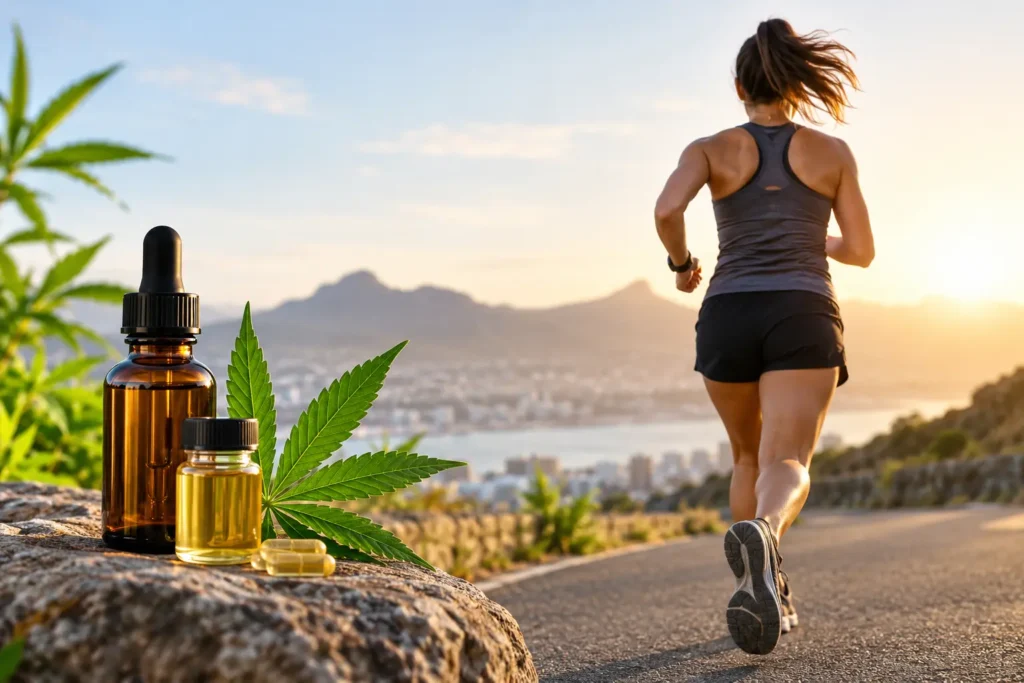
Quick Answer: CBD for runners may be useful for some people who want support with relaxation, sleep, or everyday discomfort after exercise, but current research does not show that CBD reliably improves running performance or makes runners faster. A 2024 systematic review found limited evidence for some physiological effects, while a newer randomized trial in trained runners found that 50 mg and 300 mg of CBD did not improve exercise performance or perceived exertion.
CBD also has potential risks, including drowsiness, stomach problems, liver-related concerns, and interactions with some medications. Competitive athletes should be especially careful because CBD itself is permitted by WADA, but THC remains prohibited in competition and CBD products can potentially contain THC.
Running can be simple: put on your shoes, step outside, and start moving. But regular runners know that the recovery side can be much more complicated.
Long runs can leave your legs tired. Hard training can affect sleep. Race day can bring stress and nervousness. When these problems become part of a regular training schedule, some runners start looking for additional ways to support recovery.
That is one reason CBD for runners has attracted so much attention.
CBD, short for cannabidiol, is a compound found in cannabis and hemp. Unlike THC, CBD does not produce the typical cannabis “high.” However, being non-intoxicating does not automatically mean that CBD is proven to improve athletic performance.
So, does CBD for runners actually work? The honest answer is: the research is still developing, and the evidence is much less impressive than some marketing claims suggest.
Thinking About CBD for Recovery?
Before adding CBD to your running routine, learn what current research says about its potential benefits, risks, and safety. Talk with a qualified healthcare professional to determine whether CBD is appropriate for you, especially if you take medications or have an existing health condition.
What Is CBD?
CBD, or cannabidiol, is one of the naturally occurring compounds called cannabinoids. It is different from THC, the cannabinoid primarily responsible for the intoxicating effects associated with cannabis.
CBD products can be sold in several forms, including:
- Oils and tinctures
- Capsules and softgels
- Gummies and other oral products
- Creams and balms
- Other hemp-derived preparations
CBD is often discussed in connection with the body’s endocannabinoid system, which is involved in several biological processes, including pain perception, mood, and sleep.
However, understanding how CBD interacts with the body is not the same as proving that taking CBD will improve running performance.
Why Are Runners Interested in CBD?
People searching for CBD for runners are usually interested in one or more practical concerns:
1. Post-run discomfort
After a demanding workout, muscles and joints may feel sore or uncomfortable. Some runners use CBD because they believe it may help them feel more comfortable.
The research, however, has not established CBD as a reliable treatment for exercise-related soreness.
2. Sleep and relaxation
Training is easier when you recover well. Sleep is particularly important because it gives the body time to recover between workouts.
Some CBD users report feeling more relaxed after taking it. But research specifically examining CBD as a sleep or recovery aid in athletes remains limited.
3. Pre-race nerves
A race can be physically demanding, but the mental side can be difficult too.
Some runners are interested in CBD for runners because they hope it will help them feel calmer before training or competition. Research into this area is still early, and CBD has not been shown to consistently improve race-day anxiety or performance.
4. General recovery
Recovery is more than one supplement. It includes adequate food, fluids, sleep, rest days, and sensible training progression.
CBD may be something a runner chooses to explore, but it should not replace the basics.
Does CBD Improve Running Performance?
This is one of the most important questions.
If you’re considering CBD for runners because you expect to run faster, farther, or with less effort, current evidence does not provide a strong reason to expect that result.
A 2024 systematic review examined seven studies involving healthy and physically active people. Researchers found limited evidence of beneficial effects on certain physiological measures, but evidence for strength and post-exercise recovery was limited or inconsistent. The authors also emphasized the need for more research.
More recent research provides additional context.
A randomized, double-blind crossover study involving 25 trained runners tested 50 mg and 300 mg of CBD before endurance exercise. Neither dose significantly changed perceived exertion, pain, enjoyment, mood, or anxiety during or after the exercise sessions.
The practical takeaway
CBD should not be treated as a proven performance-enhancing supplement.
If your goal is a faster 5K, longer distance, or better race time, training, nutrition, recovery, and appropriate coaching have far stronger practical importance.
Can CBD Help With Running Recovery?
Recovery is one of the biggest reasons people search for CBD for runners.
CBD has biological effects that make researchers interested in its possible relationship with discomfort, inflammation, sleep, and other recovery-related processes. But laboratory mechanisms and real-world benefits are not the same thing. The current evidence does not show that CBD consistently reduces the biological markers of muscle damage after exercise.
That means you should be cautious with claims that CBD will automatically make your muscles recover faster after a marathon or hard workout.
A better approach is to treat CBD as an optional product rather than the foundation of recovery.
Your recovery basics should still include:
- Enough sleep
- Adequate calories and protein
- Regular hydration
- Rest between difficult workouts
- Gradual increases in training volume
- Appropriate stretching or mobility work
- Treatment for injuries when necessary
CBD for Runners and Pain: What Should You Expect?
Pain is another common reason people try CBD for runners. But there is an important difference between ordinary post-exercise discomfort and an actual injury.
For example, feeling generally sore after increasing your training may be different from experiencing persistent Achilles pain, a stress injury, sharp knee pain, or pain that changes your running form.
CBD should not be used to mask pain so that you can continue training through an injury.
If pain is:
- Severe
- Getting worse
- Persistent
- Causing swelling
- Changing the way you walk or run
- Following a significant injury
It is better to speak with a qualified healthcare professional or sports medicine provider.
Feeling less pain does not necessarily mean an injury has healed.
Can CBD Help Runners Sleep?
Sleep is an important part of athletic recovery, which makes this an interesting area for CBD for runners.
Some people say CBD helps them relax, but there is not enough high-quality evidence to say that CBD reliably improves sleep in runners. There is also an important safety consideration: CBD can cause drowsiness or changes in alertness in some people.
If someone is already taking medication that causes sleepiness, combining it with CBD may increase sedation.
So rather than assuming CBD is a sleep solution, runners should first look at the basics:
- Keep a regular sleep schedule.
- Allow enough time for sleep.
- Avoid heavy training too close to bedtime if it disrupts sleep.
- Limit caffeine late in the day.
- Talk with a healthcare professional if sleep problems continue.
How Do Runners Use CBD?
There is no universally established CBD dose for running performance or recovery.
This matters because many online articles give specific dosing schedules as though they apply to every runner. They do not.
Research studies have used different doses, formulations, timing, and participant groups. The recent endurance study, for example, investigated 50 mg and 300 mg doses under controlled conditions. That does not mean those amounts are appropriate for everyone.
If you are considering CBD, discuss it with a healthcare professional, particularly if you take prescription medicines or have a medical condition.
Don’t experiment for the first time on race day
This is especially important for competitive runners.
Trying a new supplement immediately before an important race can create unnecessary problems. You may experience unexpected side effects, stomach discomfort, sleepiness, or simply find that the product does not agree with you.
CBD Oils, Gummies, Capsules, and Topicals: What’s the Difference?
People looking at CBD for runners will find many different products.
1. CBD oil or tincture
These products are taken orally and are commonly sold with a measured amount of CBD per serving.
2. CBD capsules
Capsules offer a pre-measured serving and are convenient for people who do not want to measure an oil.
3. CBD gummies
Gummies are another oral option, but products can vary considerably in ingredients and CBD content.
4. CBD topicals
Creams and balms are applied to the skin. They are commonly marketed for localized areas such as muscles and joints. A topical product should not automatically be assumed to treat an underlying sports injury.
How to Choose a CBD Product as a Runner
Product quality deserves special attention.
The CBD market contains products with varying levels of quality and labeling accuracy. The FDA has warned that some CBD products may contain unknown ingredients or make unsupported health claims.
If you decide to consider a CBD product, look for:
- Clear CBD concentration
- A complete ingredient list
- Batch-specific third-party laboratory testing
- A certificate of analysis (COA)
- Clear information about THC content
- A manufacturer that does not make unrealistic medical or performance claims
Be particularly cautious with products promising that CBD will dramatically increase endurance, eliminate injuries, or guarantee faster recovery.
Is CBD Safe for Runners?
CBD is often marketed as completely safe because it does not cause a typical THC high. That description is too simplistic.
The FDA says CBD may cause side effects such as:
- Drowsiness
- Diarrhea or other gastrointestinal problems
- Changes in appetite
- Changes in mood
The agency also warns about possible liver injury and interactions with other medications.
This is why CBD for runners should not automatically be treated like an ordinary sports drink or vitamin.
If you take prescription medication, have liver problems, are pregnant or breastfeeding, or have another health concern, talk with a healthcare professional before using CBD. FDA information also highlights concerns about CBD during pregnancy and breastfeeding.
What About CBD and Drug Testing for Athletes?
Competitive athletes need to pay special attention here.
Under the World Anti-Doping Agency’s prohibited list, CBD itself is an exception and is not prohibited. However, other cannabinoids, including THC, remain prohibited in competition.
That creates a potential problem with some CBD products.
A product can be marketed as CBD but contain THC because of contamination, inaccurate labeling, or the way it was produced. WADA specifically warns athletes about the possibility of THC contamination in non-synthetic CBD products.
If you are subject to drug testing
Do not assume that a product labeled “CBD” is automatically safe for competition.
Consider products with reliable third-party testing and carefully review the certificate of analysis. Even then, athletes should understand that supplement use can carry testing risks.
CBD for Runners: What the Research Really Says
Here is the simplest way to look at the evidence:
| Goal | Current evidence |
|---|---|
| Run faster | Not established |
| Improve endurance | Not reliably demonstrated |
| Reduce perceived effort | Mixed evidence |
| Support recovery | Limited/inconsistent evidence |
| Improve sleep | Possible, but insufficient athlete-specific evidence |
| Help with relaxation | Possible, but evidence is still developing |
| Treat a running injury | Not established |
The important point is that CBD for runners is still an area of research, not a proven performance strategy.
CBD vs. the Basics of Running Recovery
Before spending money on CBD, consider whether your recovery routine is already solid.
For most runners, the biggest opportunities are much simpler:
1. Sleep
Consistent, adequate sleep is one of the most valuable recovery tools available.
2. Nutrition
Your body needs enough energy and nutrients to support training and recovery.
3. Hydration
Replace fluids appropriately, particularly after long or hot runs.
4. Training load
Increasing mileage or intensity too quickly can contribute to overuse problems.
5. Rest
Easy days and rest days are part of training not wasted time. CBD may be something an individual chooses to explore, but it should not replace these fundamentals.
When Should You Avoid CBD?
You should be particularly cautious about using CBD without medical advice if you:
- Take prescription medications
- Have liver disease or liver concerns
- Are pregnant or breastfeeding
- Have experienced significant reactions to CBD previously
- Are a competitive athlete subject to drug testing
- Are considering CBD for a serious injury instead of getting medical care
The FDA specifically warns about medication interactions and liver-related risks associated with CBD.
Frequently Asked Questions About CBD for Runners
Is CBD good for runners?
CBD for runners may help some people with relaxation or other recovery-related goals, but there is not enough evidence to call it a proven supplement for runners. Current research does not establish CBD as a reliable way to improve running performance.
Does CBD make you run faster?
There is currently no strong evidence that CBD makes runners faster. Recent research in trained runners found no meaningful improvement in key exercise-performance outcomes after CBD use.
Can CBD help after a long run?
Some runners use CBD after demanding workouts, but research has not consistently shown that it speeds physical recovery. Sleep, nutrition, hydration, and appropriate training remain more established recovery strategies.
Can runners take CBD before a race?
Some runners may consider CBD before competition, but it is not proven to improve race performance. More importantly, competitive athletes should check anti-doping rules and product testing because THC contamination can create a drug-testing risk.
Is CBD better than THC for runners?
CBD and THC are different cannabinoids. CBD itself is not prohibited by WADA, while THC is prohibited in competition. Neither should be assumed to improve running performance.
Does CBD help running injuries?
CBD should not be considered a treatment for a running injury. Persistent or significant pain should be evaluated by an appropriate healthcare professional rather than simply being covered up with a supplement.
Is CBD safe for athletes?
CBD can cause side effects and interact with medications. Athletes who compete under anti-doping rules also need to consider the possibility of THC contamination in CBD products.
How much CBD should a runner take?
There is no universally established dose of CBD specifically for running, endurance, or recovery. Research studies use different amounts and formulations, so a dose used in a study should not automatically be treated as a personal recommendation.
Can CBD replace pain medicine or physical therapy?
No. CBD should not be used as a substitute for appropriate treatment of an injury or medical condition. If running pain persists, getting a proper assessment is more useful than simply trying to suppress the symptoms.
Final Thoughts
The interest in CBD for runners is understandable. Running places repeated demands on the muscles, joints, nervous system, and recovery routine, and many athletes are interested in additional ways to feel better between workouts.
But the current science calls for realistic expectations.
CBD has not been proven to make runners faster, and research on exercise recovery remains limited. Some runners may be interested in CBD for relaxation, sleep, or everyday discomfort, but those potential benefits should not be confused with established performance improvements.
If you decide to explore CBD, prioritize product quality, understand the potential risks, check for medication interactions, and be especially careful if you compete under anti-doping rules.
Most importantly, don’t let a supplement distract from the fundamentals that actually build better runners: consistent training, good nutrition, enough sleep, hydration, recovery, and appropriate treatment of injuries.
Sources
- Research on CBD, exercise performance, and recovery
PubMed – CBD, Performance and Post-Exercise Recovery - Recent research in trained runners
PubMed – CBD and Endurance Exercise in Trained Runners - CBD safety and drug interactions
FDA – What You Need to Know About CBD - Athlete drug testing
WADA – Prohibited List