


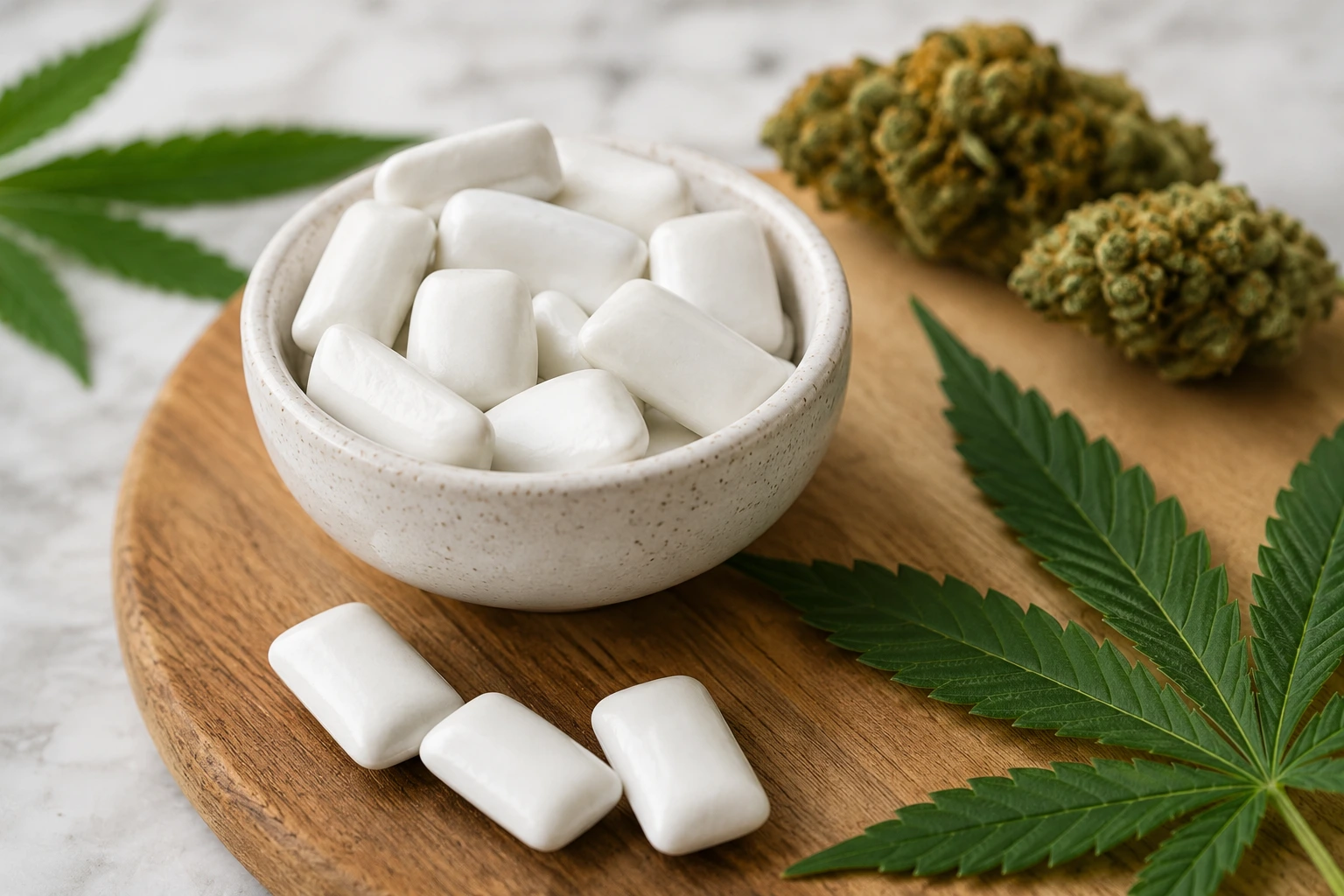
THC chewing gum is a relatively uncommon means of cannabis consumption. Rather than smoking, vaping, or consuming a regular type of gummies, THC chewing gum involves the user putting a gum product containing tetrahydrocannabinol (THC), which is the main psychoactive substance in cannabis.
However, how exactly does the THC gum work? Is it faster than a regular cannabis edible? What are the duration and strength of its effects? Is it more convenient for managing the dosage?
All this depends on the composition of the product and how the body absorbs THC. Studies of orally consumed THC reveal great variations in terms of absorption time, thus making statements about exact effects unreliable.
In this article, you will learn what THC chewing gum is and what sets it apart from other cannabis products, their possible benefits and downsides, and what you should know about it as a consumer.
What Is THC Chewing Gum?
THC gum is an oral cannabis gum that is manufactured by using a specific dosage of THC.
Contrary to regular chewing gum, THC gum is manufactured in such a way that it helps release cannabinoids during chewing. Some of the cannabinoids would be dissolved in saliva and ingested while others would be absorbed through mouth membranes.
This makes THC gum distinct from a regular edible which would be consumed and absorbed through digestion process.
The amount of THC can vary significantly between products. Rather than assuming that every piece contains the same strength, check the package for:
- THC per piece
- Total THC in the package
- Other cannabinoids, such as CBD
- Serving size
- Ingredients
- Manufacturing or testing information
- Recommended storage instructions
Product labeling and cannabis regulations also vary by location.
How Does THC Gum Work?
The principle behind the method is quite straightforward: chew the gum, activate THC, and absorb the cannabinoid through your system.
The next step after the above one might differ.
Some of the cannabinoids might be absorbed by tissues in the oral cavity, whereas the THC that is ingested is going to follow the gastrointestinal path. The oral THC, therefore, goes through the digestive tract and liver to reach the bloodstream.
That means that the mode of administration influences how fast effects set in and how long they last.
Studies that have been carried out into the oral consumption of cannabis have shown significant variations in the THC bioavailability and plasma concentrations in various products.
Will Chewing Increase the Speed of Effects from THC?
The answer is yes, but not every chewing THC gum will cause the effect in some fixed amount of minutes.
There are formulations that stimulate the absorption through the mouth, and there are those that act similar to traditional edibles. The user’s individual characteristics, ingredients of the product, duration of chewing, and presence of food might also influence the effect.
For that reason, don’t take an onset time provided in a publication for granted.
How Long Does THC Gum Take to Work?
It is difficult to provide a standard timeline for THC chewable gums.
Oral THC preparations have the possibility of a delayed onset and studies have shown that there is variability in the absorption of THC when taken orally.
This may lead to either an earlier effect than a conventional edible product, or one that resembles a conventional edible product in terms of its timing.
Several factors can influence the timing:
- THC concentration
- Product formulation
- How the gum is consumed
- Individual metabolism
- Whether you recently ate
- Cannabis tolerance
- Other substances or medications
One important rule is not to assume the product is ineffective simply because you do not feel effects immediately. Taking additional THC too soon can result in stronger effects later.
Potential Benefits of THC Chewing Gum
THC gum is not always superior to other cannabis products. There are a number of reasons why one might find such a product appealing.
1. It Is Not Associated With Smoking
Unlike smoking, the consumption of THC gum is not associated with any combustion or inhalation of smoke.
Those people who choose to avoid smoking might appreciate this feature. But that does not mean that such a product is safe. In addition to the potential risks that can be associated with consuming cannabis in general, one will not have to worry about any smoke.
2. THC Gum Can Be Discreet
As it does not produce any smoke and vapor, THC gum can be more discrete than smoking and vaping.
This does not mean that such a product can be consumed anywhere one wishes. THC gum, like all cannabis products, must be consumed in accordance with the applicable laws.
3. One Can Measure the Potency
Unlike many homemade cannabis-based products, commercial THC products come with appropriate labeling.
The presence of such labeling allows a person to understand the amount of THC that one consumes. This makes THC gum easier to control than, for instance, homemade cookies or brownies.
But the labeling cannot be considered an indication of how strong an effect will have on a consumer.
4. People Who Do Not Like Edibles Might Find THC Gum Appealing
One can find the taste of gummies or chocolate candies unpleasant. THC gum can be a suitable alternative.
5. No Smoke, No Odor
Since there is no burning, this kind of product will not generate any odor, which is often associated with smoking.
Possible Drawbacks of THC Chewing Gum
THC gum also has limitations. It should not be viewed as a risk-free alternative to other cannabis products.
1. Effects Can Be Difficult to Predict
One of the biggest challenges with oral THC is variability.
Research has found that orally administered THC can have highly variable pharmacokinetics, meaning the amount absorbed and the timing of effects can differ between people and formulations.
This makes it difficult to promise an exact onset time or duration.
2. Taking More Too Soon Can Backfire
Delayed effects are a common concern with edible cannabis.
A person may think, “This isn’t working,” and consume more. The first dose may then take effect later, resulting in a much stronger experience than intended.
Research on cannabis edibles has specifically highlighted delayed onset as a factor that can contribute to unintended overconsumption.
3. THC Can Affect Coordination and Judgment
THC can impair attention, reaction time, memory, coordination, and decision-making.
For that reason, someone who has consumed THC should avoid driving or operating machinery while impaired. Cannabis can affect people differently, and feeling comfortable does not necessarily mean that coordination and judgment are unaffected.
4. Chewing May Cause Jaw Discomfort
Like regular chewing gum, THC gum requires repetitive chewing.
People who already experience jaw tension or temporomandibular joint problems may find prolonged chewing uncomfortable.
5. Product Selection May Be Limited
THC chewing gum is a much smaller category than cannabis gummies, capsules, tinctures, or other products.
Depending on where you live, you may find relatively few choices in:
- THC strength
- Flavors
- THC-to-CBD ratios
- Package sizes
- Brands
Availability also depends on local cannabis regulations.
THC Gum vs. Traditional Edibles
The biggest difference is how the product is consumed and absorbed.
| Feature | THC Chewing Gum | Traditional Edible |
|---|---|---|
| Form | Chewing gum | Gummies, chocolates, baked goods, etc. |
| Smoking required | No | No |
| THC swallowed | Often | Yes |
| Oral absorption | May occur depending on formulation | Usually less significant |
| Onset | Can vary | Often delayed |
| Duration | Product-dependent | Often several hours |
| Dose labeling | Depends on product | Depends on product |
| Discretion | Generally high | Generally high |
Traditional oral cannabis has been studied more extensively than THC chewing gum specifically. Therefore, it is better to use general oral-THC research to understand the basic pharmacology while recognizing that a particular gum product may behave differently.
THC Gum vs. Smoking or Vaping
Smoking/vaping is an inhaled mode of administering the drug whereas THC gum is an oral drug.
Inhalation of cannabis usually leads to quick onset compared to oral ingestion of THC. This is because, in the inhalation mode of administration, the cannabinoids are absorbed through the lungs into the blood stream.
The benefit of using THC gum is that one does not have to inhale any substance.
This mode of administration is not better than the other one automatically. It all depends on various factors such as an individual’s medical conditions.
How Much THC Is in THC Gum?
There is no standard amount of THC in all cannabis gum pieces.
The concentration may differ in different products, and hence it is necessary to read the packaging label.
For those who are not aware of the product, it is essential not to assume that the THC level of the gum is the same as that of other cannabis products such as a gummy or tincture that you have tried before. This is particularly important for cannabis users for medicinal purposes.
What Should You Look for When Choosing THC Gum?
If THC gum is legal and available where you live, product quality matters.
Before purchasing, check for:
1. Clear THC labeling
The package should clearly state the amount of THC per serving and the total amount in the package.
2. Independent laboratory testing
Where required or available, look for information showing that the product has been tested for cannabinoid content and contaminants.
3. A complete ingredient list
Review the ingredients for allergens, sweeteners, artificial ingredients, and anything else you may need to avoid.
4. Legal compliance
Only purchase cannabis products through legal channels where they are permitted. Cannabis laws differ significantly between states and countries.
5. Appropriate packaging
Cannabis products should be stored securely and kept away from children and pets.
Is THC Chewing Gum Safe?
There is no simple yes-or-no answer.
THC products can cause unwanted effects, and cannabis use carries health risks regardless of the consumption method. The CDC notes that cannabis can affect the brain and body and that some users can develop cannabis use disorder.
Potential short-term effects can include:
- Drowsiness
- Dizziness
- Impaired coordination
- Changes in attention and memory
- Increased heart rate
- Anxiety or paranoia
- Confusion, particularly after consuming too much THC
The risk can vary depending on THC concentration, frequency of use, personal tolerance, age, other substances, and individual health factors.
The FDA also emphasizes that most cannabis and cannabis-derived products available commercially have not been approved by the agency to treat or cure diseases.
Who Should Avoid THC Products?
Certain people should be especially cautious about THC.
The FDA strongly advises against using THC or cannabis products during pregnancy and while breastfeeding because of potential risks to the developing fetus or infant.
You should also discuss cannabis use with a healthcare professional if you:
- Take prescription medications
- Have a history of significant heart problems
- Have experienced severe anxiety or psychosis
- Are pregnant or breastfeeding
- Are under the legal age for cannabis use in your location
- Are unsure whether cannabis is appropriate for your medical condition
Do not use THC as a substitute for prescribed treatment without speaking with your healthcare provider.
What Happens If You Take Too Much THC Gum?
Taking more THC than intended can lead to an unpleasant experience.
Possible effects include intense anxiety, confusion, dizziness, impaired coordination, excessive sleepiness, or a rapid heartbeat.
If you have consumed too much THC, avoid taking additional cannabis or other intoxicating substances. Move somewhere safe and calm, and avoid driving.
If symptoms are severe, unusual, or you are concerned about someone’s safety, seek appropriate medical assistance.
Does THC Gum Get You High?
It could.
If the THC in the gum is sufficient to induce psychoactive reactions, one will get the “high” feeling from the THC.
This will depend on the quantity used, one’s tolerance level and other things.
Cannabidiol gum is different because cannabidiol does not cause the same type of “high” as THC. But there are still risks that come with the use of cannabidiol products, including their interaction with prescription drugs. The FDA has expressed concerns regarding many unapproved cannabidiol products.
Can THC Gum Be Used for Medical Cannabis?
Other people might be attracted to THC gums because of their preference of an oral means of consuming cannabis.
It is important to note that the presence of a drug containing THC does not necessarily mean that the drug has been clinically tested and found to be an effective solution for a certain health condition. While the FDA has not approved the use of cannabis for any condition, some cannabinoid medications have been approved by the agency.
If you are planning to take THC for medical purposes, consult a health care professional first.
Frequently Asked Questions About THC Chewing Gum
What is THC chewing gum?
THC chewing gum is gum infused with tetrahydrocannabinol (THC). Depending on the formulation, THC can be released while chewing and absorbed through the mouth and/or swallowed and absorbed through the digestive system.
How quickly does THC gum work?
There is no guaranteed timeline. Oral THC absorption varies between products and individuals, and research has found considerable variability in how quickly and how strongly oral THC reaches the bloodstream.
How long do THC gum effects last?
The duration varies according to the product, THC concentration, dose, metabolism, and individual response. It is not appropriate to assume that every THC gum product will last for the same number of hours.
Is THC gum stronger than regular edibles?
Not necessarily. THC potency depends on the amount of THC in the product and how efficiently the body absorbs it. A different route of absorption does not automatically mean a product is stronger.
Can you swallow THC gum?
Follow the product’s instructions. Some THC gums are designed to be chewed and swallowed like ordinary gum, while formulations can differ. Always read the manufacturer’s directions rather than assuming every product works the same way.
Is THC gum safer than smoking cannabis?
It avoids inhaling smoke, but that does not mean it is risk-free. THC can still impair coordination and judgment and may cause unwanted psychological or physical effects.
Can THC gum cause a positive drug test?
Yes. If the product contains THC, its use can result in THC or THC-metabolite exposure that may be detected by drug testing. A product being consumed as gum rather than smoked does not eliminate this possibility.
Can you drive after using THC gum?
You should not drive while impaired by THC. Because oral THC can have delayed and variable effects, waiting until you are certain you are no longer impaired is essential.
Final Thoughts
THC gum provides yet another means of using cannabis without inhalation. This product’s discrete design and precise labeling might be desirable for some consumers, and its oral administration creates a unique effect of the cannabis product.
On the other hand, it cannot be claimed that this cannabis product is always safer or more predictable than any other cannabis product. Ingested THC tends to act in a delayed and variable fashion, thus making it especially essential to consider the labeling of the product and to refrain from ingesting more THC just because no effect has been noticed yet.
In case you consider using THC for medicinal purposes, you need to consult a healthcare provider and discuss whether cannabis is right for you.
Sources
- U.S. Food and Drug Administration (FDA) — FDA and Cannabis: Research and Drug Approval Process
FDA — Cannabis Research and Drug Approval Process - U.S. Food and Drug Administration (FDA) — Cannabis and Cannabis-Derived Products
FDA — Cannabis and Cannabis-Derived Products - Centers for Disease Control and Prevention (CDC) — Cannabis and Public Health
CDC — Cannabis Health Effects - PubMed — Oral Administration of Cannabis and THC Preparations: A Systematic Review
PubMed — Oral THC Systematic Review - PubMed — Tasty THC: Promises and Challenges of Cannabis Edibles
PubMed — Tasty THC - FDA — Cannabis Use During Pregnancy and Breastfeeding
FDA — Cannabis, Pregnancy and Breastfeeding