


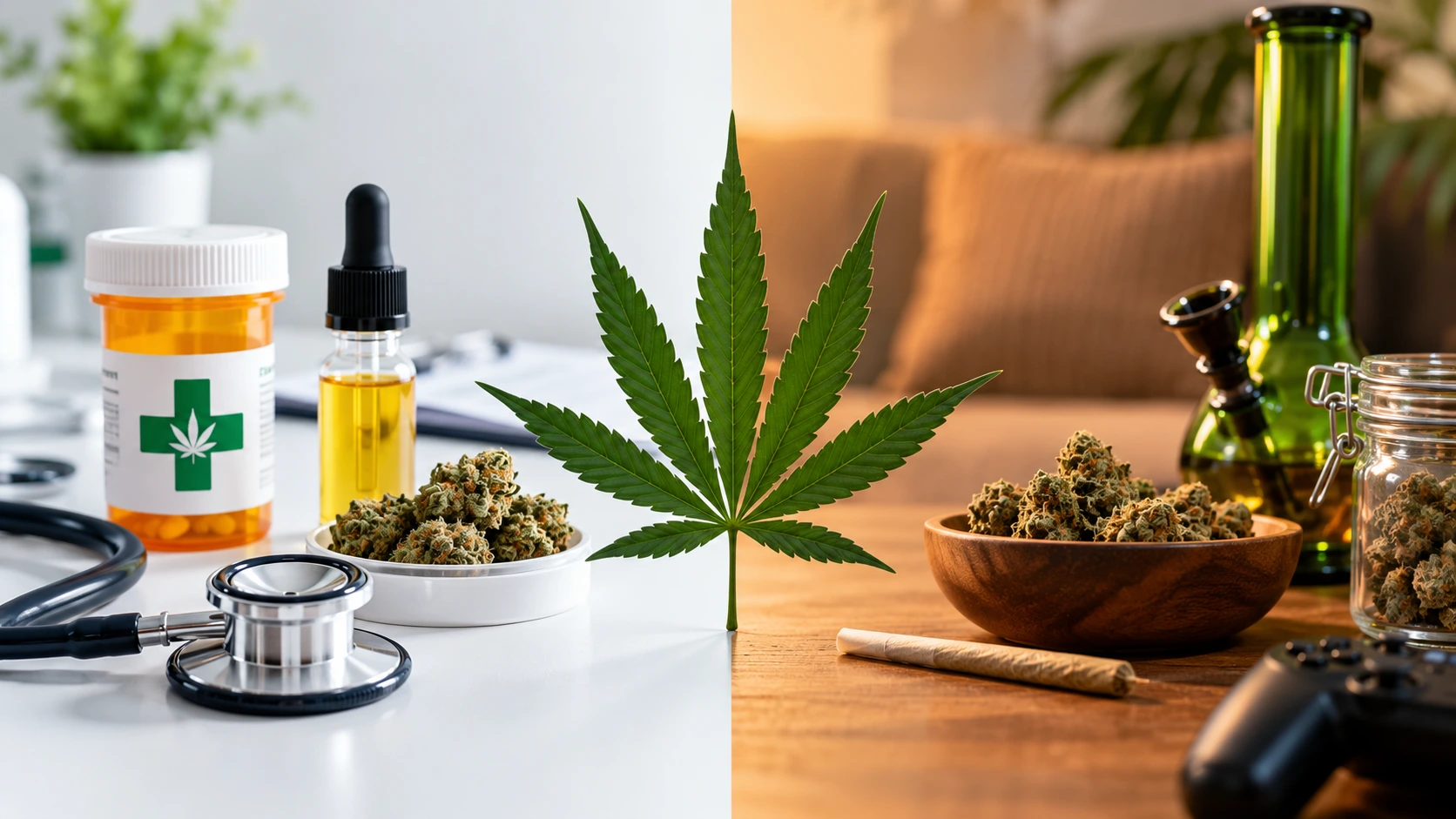
Quick Answer: Is medical marijuana better than recreational cannabis? It depends on what you mean by “better” and why you want to use cannabis.
Medical marijuana is intended for people using cannabis as part of a state-regulated medical program, while recreational cannabis, more accurately called adult-use cannabis is generally intended for adults who choose to use cannabis without a medical authorization. The cannabis itself is not always completely different. Both medical and adult-use products can contain THC, CBD, or other cannabinoids, and both can cause intoxicating effects when they contain THC.
The biggest differences are often related to purpose, state regulations, patient eligibility, purchasing rules, taxes, possession limits, and access to medical programs. The exact rules vary by state.
Many people searching for cannabis information eventually ask the same question: Is medical marijuana better than recreational? It sounds like there should be a simple yes-or-no answer. But the difference is more complicated.
Medical marijuana and recreational cannabis can come from the same plant. Both may contain THC, the cannabinoid responsible for most of cannabis’s intoxicating effects, and CBD, which does not produce the typical THC “high.”
What changes is how the cannabis is being used and how the state regulates it.
Someone looking for cannabis to help manage a health concern may have different needs from someone who wants to use cannabis for personal or social reasons. Medical programs may also provide certain legal or financial benefits that are not available through adult-use programs, depending on the state.
Before choosing either option, it helps to understand what actually makes them different.
Looking for Medical Cannabis?
If you’re considering medical marijuana for a qualifying health condition, an online evaluation can help you learn whether you may qualify for your state’s medical cannabis program.
What Is Medical Marijuana?
Medical marijuana refers to cannabis used under a state’s medical cannabis program for qualifying patients.
The exact requirements depend on where you live. Some states require a patient to have a qualifying medical condition and obtain certification or authorization from a healthcare professional. Others have different rules for registration, possession, purchasing, or cultivation.
Medical cannabis may contain different amounts of THC and CBD. Having a medical designation does not automatically mean that a product contains little or no THC.
THC can cause intoxication and can affect memory, attention, decision-making, coordination, and reaction time.
What Is Recreational Cannabis?
“Recreational cannabis” usually refers to cannabis purchased and used under a state’s adult-use cannabis laws.
In states where adult-use cannabis is legal, adults who meet the state’s age requirements can generally purchase cannabis without joining a medical cannabis program. However, the exact rules differ by state.
Adult-use cannabis may be available in many forms, including:
- Flower
- Pre-rolls
- Vapes
- Edibles
- Oils
- Concentrates
- Other infused products
These products can contain THC, CBD, or both.
So, the word “recreational“ does not necessarily describe a particular type of cannabis plant or product. It mainly describes the legal and intended use category.
Is Medical Marijuana Actually Different From Recreational Cannabis?
Sometimes, but not always.
This is one of the biggest points people miss when comparing medical marijuana with recreational cannabis.
A medical cannabis product is not automatically a completely different substance from an adult-use product. In some markets, similar or even identical types of cannabis products may be available through both systems.
The differences may instead involve:
- Who can purchase the product
- Whether a medical authorization is required
- Minimum age
- Possession limits
- Purchase limits
- Product regulations
- Taxes
- Cultivation rules
- Where cannabis can legally be used
- Patient protections
- Access to specific medical products
These rules are established at the state level and can change over time.
Medical Marijuana vs Recreational Cannabis: Key Differences
| Feature | Medical Marijuana | Recreational Cannabis |
|---|---|---|
| Main purpose | Used as part of a medical cannabis program | Adult personal use |
| Medical authorization | Often required | Generally not required |
| Eligibility | Depends on state medical rules | Depends mainly on adult-use age requirements |
| THC products | May be available | May be available |
| CBD products | May be available | May be available |
| Taxes | May differ by state | May be higher in some states |
| Possession limits | State-specific | State-specific |
| Home growing | May have different rules | May have different rules |
| Product access | Can depend on the medical program | Can depend on adult-use regulations |
| Rules | Vary by state | Vary by state |
This table is a general comparison. Your state’s laws may be different, so check current state regulations before relying on any specific limit or rule. NCSL maintains a current database of state cannabis legislation.
Why Do People Choose Medical Marijuana?
People may consider a medical cannabis program because they are looking for cannabis as part of their approach to managing a health condition or symptom.
The potential reasons vary widely. Some people discuss cannabis with a healthcare professional because of issues such as pain, nausea, sleep problems, or other symptoms.
However, cannabis is not appropriate for everyone, and evidence differs depending on the condition and the cannabis product being considered.
The CDC notes that researchers are still learning about both the potential benefits and risks of cannabis. It also points out that state-legal medical cannabis products are not the same as FDA-approved cannabis medicines.
Does Medical Marijuana Have More THC Than Recreational Cannabis?
Not necessarily.
There is a common assumption that medical cannabis must always contain less THC than recreational cannabis. That is not a reliable rule.
Medical cannabis can contain THC, and some products can contain relatively high concentrations. Adult-use products can also contain high amounts of THC.
The amount of THC matters because THC is the main compound responsible for cannabis intoxication. Higher-THC products can produce stronger effects and may increase the risk of overconsumption.
Instead of assuming that “medical” means low THC, look at the actual product information and follow the instructions provided for your situation.
What Is the Difference Between THC and CBD?
THC and CBD are two different cannabinoids found in cannabis.
THC
THC, or tetrahydrocannabinol, is the cannabinoid primarily associated with the cannabis “high.”
THC can affect:
- Memory
- Attention
- Coordination
- Decision-making
- Reaction time
- Perception
The effects can vary from person to person.
CBD
CBD, or cannabidiol, does not cause the typical high associated with THC.
However, that does not mean CBD products are completely risk-free. The CDC notes that CBD may cause side effects, can interact with some medications, and many CBD products are not FDA-regulated.
So if your concern is specifically about feeling intoxicated, the amount of THC in a product is more relevant than simply whether the product is labeled “medical” or “recreational.”
Is Medical Marijuana Safer Than Recreational Cannabis?
It would be too broad to say that medical marijuana is automatically safer.
Safety depends on several factors, including:
- THC concentration
- Amount used
- Frequency of use
- Method of consumption
- Individual response
- Previous cannabis experience
- Other medicines or substances being used
- Age and health history
The CDC states that how cannabis affects someone depends on factors such as the amount used, how often it is used, the method of use, previous experience, biology, and whether it is combined with other substances.
A medical program may provide additional healthcare guidance, but the word “medical” alone does not remove the potential risks of THC.
Does Medical Marijuana Get You High?
It can.
If a medical cannabis product contains enough THC, it can produce intoxicating effects.
Some people may experience:
- Euphoria
- Relaxation
- Sleepiness
- Changes in perception
- Slower reaction time
- Difficulty concentrating
- Dizziness
- Anxiety or uncomfortable feelings
Not everyone experiences these effects in the same way.
CBD by itself does not produce the typical THC high.
Can Recreational Cannabis Be Used for Medical Reasons?
A person may personally use adult-use cannabis because they believe it helps a symptom, but that is not necessarily the same thing as participating in a state’s medical cannabis program.
This distinction matters because medical and adult-use programs can have different legal requirements and patient protections.
If someone wants to use cannabis specifically for a health concern, discussing it with a qualified healthcare professional can help them understand potential benefits, risks, interactions, and other treatment options.
Are Medical Cannabis Products More Carefully Controlled?
The answer depends on the state and the specific product.
Cannabis regulations vary significantly across the United States. States can set their own rules for testing, labeling, licensing, product types, possession, and sales.
The CDC also notes that there are currently no federal standards for the quality and safety of cannabis products sold through state medical cannabis dispensaries. That is why consumers should not assume that every product labeled “medical” has the same level of oversight as an FDA-approved prescription medicine.
Medical Marijuana and Recreational Cannabis Can Have Similar Side Effects
The medical or recreational label does not eliminate the effects of THC.
THC-containing cannabis may affect attention, memory, coordination, judgment, and reaction time.
Other possible effects can include:
- Dry mouth
- Drowsiness
- Dizziness
- Increased heart rate
- Anxiety
- Confusion
- Problems with concentration
The experience depends on the individual and the product.
Products with high THC concentrations can have stronger intoxicating effects and may increase the risk of consuming too much.
Does the Way You Use Cannabis Matter?
Yes.
The method of consumption can change how quickly effects appear and how long they last.
For example, inhaled cannabis can produce effects relatively quickly, while edible cannabis can take longer to produce noticeable effects.
The delayed effects of edibles are particularly important because someone may consume more before realizing that the first amount has taken effect. The CDC warns that edible cannabis can take 30 minutes to 2 hours to produce intoxicating effects and can cause effects that last longer than expected.
This is one reason people should follow product instructions carefully and avoid taking additional amounts simply because effects have not appeared yet.
Which Is Better for Medical Use?
There is no single answer that applies to everyone.
If someone has a medical reason for considering cannabis, a medical cannabis program may offer advantages related to patient eligibility, healthcare guidance, or state-specific protections.
If someone does not qualify for a medical program and lives somewhere adult-use cannabis is legal, an adult-use program may be the available legal option.
The important question is not simply:
“Is medical marijuana better than recreational?”
A better question is:
“Which option fits my health needs, legal situation, and goals?”
The answer depends on the person’s circumstances and the laws where they live.
Are Medical Marijuana Products Less Intoxicating?
Not automatically.
A product’s intoxicating effect is influenced largely by its THC content and how it is used not simply by whether it was purchased through a medical or adult-use program.
A medical product with THC can make someone feel high.
Likewise, an adult-use product with lower THC may produce less noticeable intoxication. Always check the product’s cannabinoid information rather than assuming that the category tells you how strong its effects will be.
Can You Drive After Using Medical or Recreational Cannabis?
Using cannabis can impair skills needed for safe driving.
THC can affect attention, coordination, decision-making, and reaction time. That means having a medical cannabis authorization does not make it safe to drive while impaired.
The same principle applies to adult-use cannabis. Do not drive, operate machinery, or perform other safety-sensitive activities if cannabis has impaired you.
Can Medical Marijuana Be Better for Cost?
Sometimes, but it depends on the state.
Medical and adult-use cannabis can be subject to different tax structures and purchase rules. Some states provide tax advantages to registered medical cannabis patients, while others may have different pricing or purchasing rules.
Because cannabis laws change, cost should be checked using current state information rather than assuming that medical cannabis is always cheaper.
Can Medical Marijuana Help You Avoid a “Recreational” Label?
A medical cannabis program is different from adult-use cannabis in terms of legal status and program participation.
But it is important not to assume that having medical authorization changes every cannabis-related law. Rules involving driving, employment, federal law, firearms, housing, public consumption, and other issues can be complicated and may vary by jurisdiction.
For legal questions, check the current laws that apply to your location.
What About Drug Testing?
Medical authorization does not necessarily mean a cannabis drug test will be negative.
Many drug tests look for cannabis-related metabolites rather than asking whether cannabis was used medically or recreationally. Therefore, a medical cannabis authorization does not automatically prevent THC-related test results.
Employment and drug-testing laws vary by location and situation, so anyone concerned about workplace testing should check the rules that apply to them.
Does Having a Medical Card Mean Cannabis Is Completely Legal?
No.
A medical cannabis card or authorization generally operates within a state’s medical cannabis framework. It does not make cannabis legal everywhere or remove every restriction.
State cannabis programs can have rules covering:
- Where cannabis can be purchased
- How much can be possessed
- Where it can be used
- Home cultivation
- Transportation
- Age requirements
- Driving
- Product types
State laws also change. NCSL’s cannabis legislation database tracks enacted cannabis laws across states and is updated regularly.
What Should You Consider Before Choosing Medical or Recreational Cannabis?
If you’re deciding between the two, consider these questions:
1. Why do you want to use cannabis?
If the reason is related to a health condition or symptom, speaking with a healthcare professional can help you understand whether cannabis is appropriate.
2. Do you qualify for your state’s medical program?
Eligibility requirements vary by state.
3. What are the costs?
Compare product prices, taxes, registration fees, and other costs that apply in your state.
4. What THC level is appropriate?
THC strength can affect intoxication and the likelihood of unwanted effects. Higher THC concentrations can produce stronger effects.
5. Are you taking other medications?
Cannabis and CBD can interact with other medicines. The CDC specifically warns that CBD may interfere with some medications.
6. Do you need to drive or work soon afterward?
If cannabis affects your attention, coordination, or reaction time, driving or other safety-sensitive activities can become dangerous.
So, Is Medical Marijuana Better Than Recreational?
Medical marijuana is not automatically better than recreational cannabis, and recreational cannabis is not automatically better than medical cannabis.
They serve different purposes and operate under different state rules.
Medical marijuana may make more sense for someone who wants to participate in a state medical cannabis program for a health-related reason. Adult-use cannabis may be the legal option for adults who want cannabis for personal use in a state that permits it.
The actual cannabis product also matters. THC content, CBD content, potency, method of use, and individual response can all affect the experience. If you are considering cannabis for a medical reason, the most useful starting point is to understand your state’s medical program and discuss your situation with a qualified healthcare professional.
Frequently Asked Questions
Is medical marijuana better than recreational cannabis?
Not necessarily. The two are regulated for different purposes, and the better option depends on your medical needs, eligibility, location, cost, and applicable laws.
Does medical marijuana have less THC?
Not always. Medical cannabis can contain THC at different concentrations, including products with relatively high THC levels.
Does medical marijuana get you high?
It can if the product contains THC. THC is the primary cannabinoid responsible for cannabis intoxication.
Does CBD get you high?
CBD by itself does not cause the typical THC high. However, CBD products may contain THC or other substances, so product labeling matters.
Is recreational marijuana stronger than medical marijuana?
Not necessarily. Strength depends on the specific product and its THC concentration rather than simply whether it is sold through a medical or adult-use program.
Is medical marijuana safer than recreational marijuana?
The medical designation does not automatically make cannabis safer. Risks can depend on THC concentration, amount used, method of consumption, individual factors, and other substances or medications.
Can you drive after using medical marijuana?
Medical authorization does not make driving while impaired safe. THC can affect attention, coordination, judgment, and reaction time.
Can you use recreational marijuana for medical reasons?
Someone may personally use adult-use cannabis for a symptom, but that is different from participating in a state’s medical cannabis program. The legal rules depend on the state.
Is medical marijuana cheaper than recreational marijuana?
It can be in some states because medical cannabis programs may have different taxes or fees. However, prices and rules vary, so there is no universal answer.
Does having a medical marijuana card protect you from drug testing?
No. A medical authorization does not necessarily prevent a cannabis-related drug test from detecting THC metabolites. Workplace and testing rules vary.
Final Thoughts
When asking “Is medical marijuana better than recreational?” there is no universal answer.
Medical cannabis and adult-use cannabis can contain many of the same cannabinoids, including THC and CBD. The major differences often come from why cannabis is being used, who can access each program, state regulations, taxes, possession rules, and available patient protections.
Most importantly, don’t assume that medical cannabis cannot make you high or that it is automatically safer. THC can cause intoxication regardless of whether cannabis was obtained through a medical or adult-use program.
If you’re considering cannabis for a health concern, learn the rules in your state and talk with a qualified healthcare professional about potential benefits, risks, and other treatment options.
Sources
- Centers for Disease Control and Prevention (CDC) — Cannabis Frequently Asked Questions
CDC Cannabis FAQs - Centers for Disease Control and Prevention (CDC) — State Medical Cannabis Laws
CDC State Medical Cannabis Laws - National Conference of State Legislatures (NCSL) — State Cannabis Policy Enactment Database
NCSL State Cannabis Policy Database - Centers for Disease Control and Prevention (CDC) — About CBD
CDC About CBD - National Conference of State Legislatures (NCSL) — State Medical Cannabis Laws
NCSL State Medical Cannabis Laws