


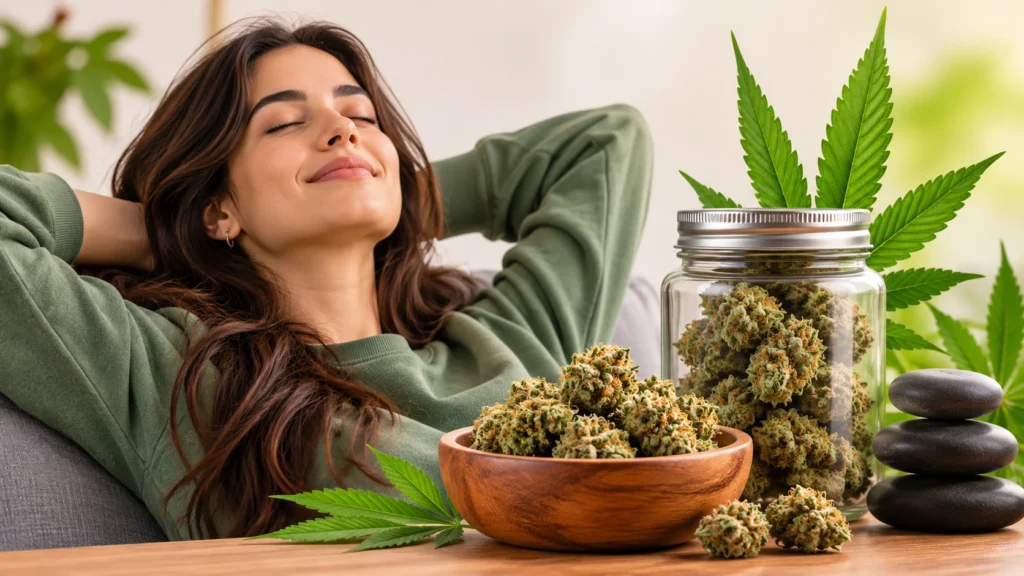
Quick Answer: Indica-labeled cannabis strains are commonly associated with relaxation, physical calmness, and sleepiness. Popular examples include Northern Lights, Granddaddy Purple, Bubba Kush, and Hindu Kush. However, no particular strain guarantees a relaxing experience. The effects depend on the product’s THC and CBD content, other plant compounds, individual sensitivity, and the amount consumed. Some cannabis products may cause anxiety or panic instead of relaxation, especially when they contain high levels of THC.
After a long and stressful day, many people look for ways to unwind and feel more comfortable. This is one reason cannabis strains associated with relaxation attract so much attention. Some people describe certain marijuana varieties as calming, while others report feeling sleepy, happy, or physically relaxed.
But which marijuana makes you relax? Is Indica better than Sativa? Does CBD help you feel calmer? And which cannabis strains are commonly associated with a peaceful experience?
Understanding the differences between cannabis strains and their chemical composition can help you make sense of these questions. It is also important to understand that cannabis affects everyone differently. A strain that one person describes as relaxing may make another person feel anxious or uncomfortable.
This guide explains popular relaxing cannabis strains, their commonly reported effects, the role of THC and CBD, and important safety considerations.
Which Marijuana Makes You Relax the Most?
Indica-labeled marijuana is traditionally associated with relaxing and calming effects. People often describe these products as producing a heavier physical sensation, sometimes called a body high.
However, the terms Indica and Sativa do not reliably predict how a particular cannabis product will affect you. Research shows that these labels are not dependable indicators of a product’s chemical makeup or therapeutic effects.
If you are researching relaxing marijuana, pay attention to the product’s cannabinoid profile, THC and CBD levels, and individual effects rather than relying only on its strain name.
Some cannabis varieties commonly marketed as relaxing include:
- Northern Lights
- Granddaddy Purple
- Bubba Kush
- Hindu Kush
- Purple Kush
- Blueberry
These are commonly described in cannabis communities as relaxing or physically calming varieties. Their actual effects can vary depending on genetics, cultivation, processing, and product composition. There is not enough clinical evidence to rank these strains or confirm that they provide specific medical benefits.
6 Popular Marijuana Strains Commonly Associated With Relaxation
Certain cannabis strain names appear frequently in discussions about relaxation. Here is what people commonly report about them.
1. Northern Lights
Northern Lights is a well-known cannabis variety traditionally described as an Indica.
Commonly reported effects:
- Physical relaxation
- Sleepiness
- A calm or mellow feeling
- Reduced mental stimulation
Some cannabis users associate Northern Lights with evening relaxation. However, its effects are not guaranteed, and THC levels can differ between products sold under the same name.
2. Granddaddy Purple
Granddaddy Purple, also called GDP, is another popular variety commonly marketed as an Indica.
Commonly reported effects:
- A heavy physical sensation
- Sleepiness
- A relaxed mood
- A mellow experience
Its purple-colored buds and grape-like aroma make it recognizable. Some users associate it with nighttime use, although scientific research has not established that this strain improves sleep.
3. Bubba Kush
Bubba Kush is commonly described as a relaxing, Indica-dominant variety.
Commonly reported effects:
- Physical heaviness
- Sleepiness
- A calm feeling
- Reduced activity or alertness
It is often discussed by people looking for a less energetic cannabis experience. However, individual reactions may differ considerably.
4. Hindu Kush
Hindu Kush is a traditional cannabis variety associated with the Hindu Kush mountain region.
Commonly reported effects:
- Physical relaxation
- A mellow mood
- Sleepiness
- A heavy body sensation
Its name is often associated with traditional Indica-style cannabis. However, the strain label alone cannot tell you exactly how a particular product will affect you.
5. Purple Kush
Purple Kush is another variety commonly marketed as an Indica.
Commonly reported effects:
- A relaxed physical feeling
- Sleepiness
- A mellow mood
- Reduced alertness
People often associate it with evening use. However, its effects depend on its actual cannabinoid content and the individual’s sensitivity to cannabis.
6. Blueberry
Blueberry is a popular cannabis variety known for its sweet, berry-like aroma.
Commonly reported effects:
- A relaxed mood
- Physical calmness
- A pleasant or uplifting feeling
- Sleepiness in some users
Although blueberry is often discussed as a relaxing variety, not everyone experiences the same effects.
Remember: These descriptions reflect common consumer reports and marketing descriptions, not proven medical benefits. A strain name is not a substitute for laboratory-tested product information.
Indica vs. Sativa: Which Is Better for Relaxation?
Indica and Sativa are two common labels used in the cannabis market. Many people believe that Indica produces relaxation while Sativa provides energy and focus.
Here is how they are traditionally described:
| Feature | Indica-Labeled Cannabis | Sativa-Labeled Cannabis |
|---|---|---|
| Common description | Relaxing | Uplifting |
| Reported sensation | Physical heaviness | Mental stimulation |
| Common association | Evening use | Daytime use |
| Possible experience | Sleepiness | Increased alertness |
| Important limitation | Effects vary | Effects vary |
Hybrid products combine characteristics associated with Indica and Sativa varieties.
So, is Indica always better for relaxation?
No. These labels are not scientifically reliable enough to predict how someone will respond. A 2026 systematic review found that Indica, Sativa, and Hybrid labels do not consistently predict cannabis composition or human effects.
Instead of choosing a product based only on its category, consider its measured cannabinoid content and discuss potential risks with a qualified healthcare professional.
How Do THC and CBD Affect Relaxation?
THC and CBD are two of the best-known compounds found in cannabis. They interact with the body’s endocannabinoid system but have different effects.
Understanding the difference can help explain why some cannabis products feel relaxing while others produce unwanted effects.
What Is THC?
THC stands for tetrahydrocannabinol. It is the primary intoxicating compound in marijuana and is responsible for much of the cannabis high.
Depending on the product and individual, THC may be associated with:
- Euphoria or a feeling of being high
- Changes in mood
- Sleepiness
- Altered perception
- Temporary physical relaxation
However, more THC does not necessarily mean more relaxation.
High-THC products can also cause:
- Anxiety
- Panic
- Paranoia
- Dizziness
- Increased heart rate
- Confusion
People with little experience using cannabis may be particularly sensitive to these unwanted effects.
What Is CBD?
CBD stands for cannabidiol. Unlike THC, it does not produce the typical intoxicating cannabis high.
CBD is being studied for its possible effects on anxiety, inflammation, pain, and other health concerns.
Some research suggests that CBD may have anxiety-related benefits, but the evidence is still limited. CBD products should not be considered a proven treatment for anxiety or a guaranteed way to relax.
THC vs. CBD: What’s the Difference?
| Feature | THC | CBD |
|---|---|---|
| Full name | Tetrahydrocannabinol | Cannabidiol |
| Intoxicating effect | Yes | No typical cannabis high |
| Possible effects | Euphoria, sleepiness, altered perception | Non-intoxicating effects |
| Anxiety response | May increase anxiety, particularly at higher exposure | Being studied for possible anxiety-related effects |
| Research | Better studied for intoxication and impairment | Clinical evidence remains limited for many uses |
The balance between THC and CBD may influence how a product feels, but it does not guarantee a particular result.
What Makes Some Cannabis Strains Feel More Relaxing?
The effects of marijuana are not determined by its strain name alone. Several factors may influence how someone feels after cannabis exposure.
1. Cannabinoid Content
Cannabinoids are naturally occurring compounds in cannabis.
THC and CBD are the most widely studied cannabinoids. Their amounts and relative proportions can influence the overall effects of a product.
A product with high THC content may produce stronger intoxicating effects, but it can also increase the risk of anxiety and other unwanted reactions.
2. Terpenes
Terpenes are natural compounds that contribute to the smell and flavor of cannabis.
Some commonly discussed cannabis terpenes include:
- Myrcene: Often associated with earthy and herbal aromas.
- Linalool: Known for its floral scent.
- Limonene: Has a citrus-like aroma.
- Beta-caryophyllene: Often described as having a spicy or peppery scent.
Researchers are studying whether terpenes influence cannabis effects. However, claims that a specific terpene reliably produces relaxation or treats anxiety are not yet supported by strong clinical evidence.
3. THC Potency
THC concentration is another important factor.
A higher THC percentage does not automatically mean a better or more relaxing experience. Strong THC exposure can increase the likelihood of unwanted effects, including anxiety, panic, and impaired coordination.
4. Individual Sensitivity
Two people can have very different experiences with the same cannabis product.
Their reactions may depend on:
- Previous cannabis experience
- Individual sensitivity to THC
- Overall health
- Age
- Other medications or substances
- The product’s chemical composition
This is why strain descriptions should be treated as general information rather than a guarantee.
What Are the Potential Benefits of Relaxing Marijuana?
Some people use cannabis because they believe it helps them unwind or manage certain symptoms. However, the potential benefits depend on the product, the person’s health, and the condition being treated.
Here are some commonly discussed areas of interest:
1. A Temporary Feeling of Relaxation
Cannabis may produce temporary feelings of relaxation or euphoria in some people. However, this experience is not consistent. Other people may feel restless, anxious, or uncomfortable.
2. Possible Effects on Sleep
Some people report feeling sleepy after using THC-containing cannabis products.
Research has examined cannabinoids for sleep-related problems, but the evidence is limited and varies by product and medical condition. Cannabis should not be considered a proven long-term solution for insomnia.
3. Possible Effects on Pain
Certain cannabinoid-based medicines have been studied for specific types of chronic pain.
However, evidence for cannabis products varies, and not every product has the same effects. People experiencing ongoing pain should speak with a healthcare professional about appropriate treatment options.
4. Possible Effects on Anxiety
CBD and THC are both being studied for their effects on anxiety.
Some research suggests that CBD may have potential in certain anxiety-related situations. THC, on the other hand, can increase anxiety in some people, particularly at higher exposures.
Cannabis is not a proven replacement for established anxiety treatments.
Can Marijuana Make You More Anxious Instead of Relaxed?
Yes. Although some people describe cannabis as calming, it can also produce the opposite experience.
THC affects the brain and can change mood, perception, and thinking. Depending on the amount and individual sensitivity, someone may experience:
- Nervousness
- Racing thoughts
- Increased heart rate
- Fear or panic
- Paranoia
- Confusion
- Dizziness
High-THC products and large amounts can increase the likelihood of unpleasant reactions.
A 2026 systematic review of controlled studies found that THC increased anxiety and tiredness compared with placebo in the populations studied. This is an important reminder that feeling relaxed is not a guaranteed effect of marijuana.
If cannabis causes anxiety or panic, stop using it and seek medical advice if symptoms are severe or do not improve.
How to Choose Cannabis Products More Carefully
If you are researching cannabis products, looking beyond the strain name can help you understand what you are considering.
Keep these points in mind:
1. Check the cannabinoid information
Look for reliable laboratory testing that shows THC and CBD content. Do not assume a strain name tells you how strong a product is.
2. Be cautious with high-THC products
Products with high THC concentrations may increase the risk of anxiety, panic, and impairment.
3. Understand the product type
Cannabis flowers, oils, concentrates, and edibles can have different strengths and effects. Edibles may take longer to produce noticeable effects, which can increase the risk of consuming too much.
4. Avoid mixing cannabis with alcohol
Combining cannabis with alcohol or other substances can increase impairment and unwanted effects.
5. Speak with a healthcare professional
If you are considering cannabis for a medical condition, discuss your health history, current medications, and treatment options with a qualified healthcare professional.
Is Relaxing Marijuana Safe for Everyone?
No. Cannabis is not risk-free, even when a product is marketed as relaxing. Certain people should be particularly cautious or avoid cannabis altogether.
- Teenagers and young adults: Cannabis can affect brain development.
- Pregnant or breastfeeding individuals: Cannabis use may harm the developing baby.
- People with certain mental health conditions: THC may worsen anxiety, paranoia, or psychotic symptoms.
- People taking medications: Cannabis may interact with certain prescription and over-the-counter medicines.
- People with heart conditions: THC can increase heart rate and affect blood pressure.
Cannabis can also affect memory, attention, coordination, and reaction time.
Never drive or operate machinery after using cannabis. Keep cannabis products securely stored away from children and pets.
Frequently Asked Questions
1. Which marijuana makes you relax the most?
Indica-labeled varieties are traditionally associated with physical relaxation and sleepiness. Northern Lights, Granddaddy Purple, Bubba Kush, and Hindu Kush are commonly described this way. However, their effects are not guaranteed and depend on their chemical composition and individual sensitivity.
2. Is Indica or Sativa better for relaxation?
Indica is traditionally associated with relaxation, while Sativa is often marketed as more uplifting. However, scientific evidence does not support using these labels alone to predict a person’s experience.
3. Which cannabis strains are commonly associated with relaxation?
Popular examples include Northern Lights, Granddaddy Purple, Bubba Kush, Purple Kush, Hindu Kush, and Blueberry. These descriptions are based mainly on consumer reports rather than clinical evidence.
4. Does CBD or THC make you feel more relaxed?
THC can produce temporary relaxation in some people, but it can also cause anxiety and panic. CBD does not produce the typical cannabis high and is being researched for possible anxiety-related effects. Neither guarantees relaxation.
5. Can marijuana help with stress?
Some people report temporary feelings of relaxation after using cannabis. However, scientific evidence does not establish marijuana as a reliable treatment for everyday stress. THC may also increase anxiety in certain individuals.
6. Does relaxing marijuana make you sleepy?
Some THC-containing products may cause drowsiness or sleepiness. However, the effect depends on the product and individual. A relaxing experience does not always mean better sleep.
7. Can high-THC marijuana cause anxiety?
Yes. High-THC exposure can increase the risk of anxiety, panic, paranoia, and other unwanted effects. People with limited cannabis experience may be more sensitive.
8. Are hybrid marijuana strains relaxing?
Some hybrid varieties are marketed as relaxing, while others are described as uplifting. Their effects depend on their actual chemical composition rather than the hybrid label alone.
9. Do terpenes make marijuana more relaxing?
Terpenes contribute to cannabis aroma and flavor. Researchers are studying their possible effects, but there is not enough clinical evidence to say that particular terpenes reliably make marijuana more relaxing.
10. Is marijuana a proven treatment for anxiety or insomnia?
No. Cannabis is not an established first-line treatment for anxiety or insomnia. Some cannabinoids are being studied for these conditions, but more high-quality research is needed to understand their effectiveness and safety.
Final Thoughts
So, which marijuana makes you relax? Indica-labeled varieties such as Northern Lights, Granddaddy Purple, Bubba Kush, and Hindu Kush are commonly associated with calming and physically relaxing effects.
However, choosing cannabis based only on its strain name can be misleading. THC and CBD levels, other plant compounds, individual sensitivity, and product strength all play a role in how cannabis affects the body and mind.
It is also important to remember that marijuana does not relax everyone. Some products, particularly those with high THC concentrations, may cause anxiety, panic, or other unwanted effects.
If you are considering cannabis for a health-related reason, speak with a qualified healthcare professional before making a decision. Understanding both the potential effects and the risks is essential for making an informed choice.
Sources
- National Institutes of Health – Cannabis and Its Effects
Explains THC, CBD, relaxation, anxiety, and the effects of cannabis on the body. - CDC – Cannabis Health Effects
Covers possible health effects, mental health risks, and cannabis-related impairment. - Health Canada – Cannabis and Your Health
Explains THC potency, CBD, anxiety, and potential side effects. - 2026 Systematic Review – Indica, Sativa, and Hybrid Labels
Examines whether cannabis strain labels reliably predict chemical composition and effects. - 2026 Research Review – THC and Its Subjective Effects
Reviews how THC affects anxiety, tiredness, calmness, and other subjective experiences. - Health Canada – Cannabis Information for Healthcare Professionals
Provides scientific information about cannabinoids, anxiety, sleep, and cannabis safety.